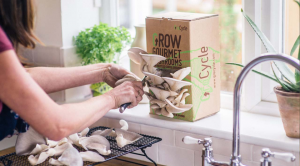
Package by Magdalena A Kolodziej

The content of this poem

Is fully recyclable.

These words will be

Rearranged and reused

In a different way than here.


But if these words are recycled,

Who will listen for the cries

That are trapped here?

Who’ll see the tears you didn’t know

Were contained here till

I told you they were?


What if these recycled words

Told you that there are children

Who cannot even cry anymore?

What if these recycled words told you

That their trade is as impure as their water?

Or if it is so diseased they cannot even

Produce tears but still bring you your tea?


This recyclable package of words

Can’t even contain

Their loudest screams for help

For there is unfairness in their trade.

But will you try to make it fair

With the help of nothing,

But recycled words?


meMagdalena Kolodziej is a Polish student based in London, who is currently studying English Literature with Creative writing. Having worked in a library for a few years, she had been able to access many inspiring stories that allowed her writing to flourish. Ever since she was eight, she had been writing poetry and short stories. Recently she turned her attention to expanding her fictive writing into blog writing for StudentJob, where she develops her writing skills in the aim to help other students with university experiences.

Ethical Beauty Buys by Shakela Begum

I love everything to do with beauty. Only several years ago, I had a handful of not-so-good products. It was only when I got my first job that I started to invest in more, better quality makeup.

Recently, I have become more conscious about them though. What ingredients are used to make them? Where are they sourced from? Have they been tested on animals?

As a consumer, I have the power and responsibility to spend my money on whatever I want. So why should I be paying companies that are hurting fluffy, little bunnies? The problem is a lot of us just don’t think too much about what we’re putting into our shopping baskets.

Untitled

I believe that making the first step towards buying ethical or Fairtrade items can be tricky. Where do you start? Well, if we all took some time to read product labels and do some research on the brands that we love, we can learn more about them.

Here’s what I’ve come across in my search for ethical/Fairtrade beauty:

  • Brands that are cruelty free usually show this on their packaging with an image of a bunny or explicitly say so.
  • Brands that are Fairtrade have the logo on their packaging.
  • A lot of the time if you’re unsure about the details, you can easily find your answers online.

Brands that I’ve found:

  • Lush: “Lush consistently works hard to source materials and develop relationships with producers that are as direct and transparent as possible […] Lush uses a variety of ingredients, some of which are not able to be certified Fairtrade.” They also fight against animal testing, hand-make their products and are suitable for vegetarians. (https://weare.lush.com/lush-life/our-policies/fair-trade/)
  • The Body Shop: is leading the way to all things Fairtrade and ethical, as well as running other important campaigns. Their website is jam packed with information with what they are actively doing to help the world. (http://www.thebodyshop.co.uk/values/index.aspx)
  • (by Superdrug): “It’s our vision to be part of what makes you and your life beautiful.” B. is both cruelty free and vegan friendly – the best of both worlds! As well as carrying makeup and skincare items, they also have a range of products for men. (http://www.superdrug.com/brandshop/B)

Sometimes when we think about making the transition to buying ethical/Fairtrade items, we often think about the higher price tag that is attached to them. But, what you should consider is the fact that you’re investing in something positive and supporting these companies.

It has been rewarding to learn so much about ethical/Fairtrade online, and it wasn’t as hard as I thought it would be. There are countless videos on Youtube that talk about it.

When it comes down to the basics, we want to be purchasing from companies that are simply fair. If we all take small step towards investing in better products, we can all live in a better world and know that we are contributing to the greater good.

Interview with Adam Sayner, Director of GroCycle

Ever wondered what happens to all those coffee grounds after the water’s run through it to make your cappuccino? Of course, it goes to landfill. We drink about 80 million cups of coffee every day, and that’s just the UK. But what else can you do with used coffee grounds?

One social enterprise has discovered a beautiful solution. At GroCycle, Adam and Eric have been using waste coffee since 2011 to grow gourmet Oyster mushrooms. Sounds weird, right? Well, according to Adam, the ‘traditional’ way to grow mushrooms is on straw and sawdust, so it’s not that weird after all.

home-full-width-1-image

In social enterprise schemes positive outcomes aren’t measured against monetary gains but environmental or social good. GroCycle are a not-for-profit Community Interest Company – all the money they make goes straight back towards making beneficial changes in the way we live. Their aim is pretty simple: to keep coffee waste out of landfill.

In their first year they collected 5 tonnes of the stuff. “We definitely got some strange looks when walking into some cafes and asking for their coffee waste to grow mushrooms on! But after we explain it, almost every café is really supportive and they’re happy to see their waste go to good use.” On top of finding a use for the waste, Adam says that “the brewing process pasteurises the grounds, making it an easier way to grow the mushrooms than the traditional method.”

In the early days they’d experimented growing other kinds of mushrooms like Shiitake, Lion’s Mane, King Oyster and Pioppino, but it was only the Oyster mushrooms that could grow on pure coffee. “Oyster mushrooms are well known to grow on lots of different substrates so if any mushrooms can grow on coffee, it’ll be them!”

From collecting 5 tonnes of coffee in their first year, last year GroCycle produced 5 tonnes of gourmet Oyster mushrooms, all from recycled coffee! They used more than 20,000 kilos of waste grounds – with a humble team of four people. “Although we are a small team, we are beginning to have a big impact,” Adam says. “More than 7000 people grew their own mushrooms at home with our kits, and we now run a popular online course which teaches people in 35 countries around the world how to grow mushrooms on coffee. This is a big part of what we’re about: spreading and teaching the idea to others.”

A big part of this is the way GroCycle is run, and Adam tells me he’d always seen business as a potential driver for positive change. “The motto ‘trading for people and planet’ is used by the Social Enterprise Mark, which we are accredited by, and I think it fits the bill perfectly. GroCycle achieves a meaningful social and environmental benefit in the work that we do.”

That benefit is partly achieved by the locality of the project; they’re now regularly collecting waste coffee from the five biggest cafés in Exeter city centre. For Adam, sourcing our food more locally is an integral part of forging a more sustainable future. “It’s an incredibly important part of how we can begin to reduce our impact on the planet and create a vibrant food economy. When you eat food that has been produced locally it will usually have consumed less energy, it’ll be fresher, it’ll taste better, and you will be supporting the people in your local community that are growing it.”

“Our biggest aim for the years ahead is to support others in countries around the world to set up growing mushrooms in a low impact way. We have built so much knowledge over the last few years and are often asked if we can assist people and offer advice. As a small non-profit organisation it can often be difficult to have enough time for this, but we have found teaching via an online course a great way to do it. We are currently planning a flagship course which will launch later this year. It’ll teach people how to set up grow rooms, and cover the practicalities and economics of production.”

Introducing our new Fairtrade intern: Daniela Gangan!

daniela photoI am Daniela Gangan and I will be joining the Sustainability team as a Fairtrade intern.

I am a first year student at the University of Greenwich, currently studying Business with Law. I moved from Romania to the UK for a change of environment, educational system and way of thinking. I like challenges and getting involved in a variety of projects in order to gain experience. Sometimes I volunteer and I like getting to know new people from different backgrounds. I am passionate about sport, music and photography.

I consider this internship to be a great opportunity to get involved with sustainability at Greenwich and to learn more about ethical business and the importance of supporting local producers. Furthermore, I am excited about the chance of studying sustainability in more detail, a growing movement in the UK. In addition to the knowledge gained from my course, my Fairtrade internship will allow me to understand better the consumer insight of ethical brands and give me experience of event organization for Fairtrade Fortnight. Studying Business with Law, I would like to develop professional skills that can help me in my future career. Similarly, ethical and positive businesses are essential to sustainability. I believe that getting more people involved in sustainability will improve the chances of moving to a sustainable society.

What is Fairtrade?                                            FT logo
Fairtrade is about better wages, decent working conditions, local sustainability and fair terms of trade for producers in developing countries. It has a strong vision of justice and sustainable development in all trade structures and practices.

The Fairtrade Foundation is a charitable organization that has expanded to Europe, Japan, North America, and Mexico, with the launch of the first Fairtrade label Max Havelaar in 1988. The Fairtrade major principles are to cope with poverty and injustice through trade, and to bring together producers and consumers in a vision to move to a more sustainable society. Therefore, for certain products (such as coffee, cocoa, cotton and rice) Fairtrade only certifies small farmer organisations. Fairtrade standards protect workers’ rights according to International Labour Organization conventions, including health and safety standards, freedom of association, collective bargaining, no discrimination and no bonded or illegal child labour. Since Fairtrade’s beginnings in the 1980s and the launch of the current Fairtrade Mark in 2002, Fairtrade has become the most widely recognized ethical label in the world and is a growing brand in the UK. It is a chance to start protecting natural resources, to produce goods with care and to convince customers that Fairtrade products are better in the longer-term. However, it needs a lot of dedication and involvement to find and to create best deals for farmers and to gain the trust of people who would invest in a brighter future, thus the Fairtrade Foundation work hard in order to do this.

Fairtrade is about trust and transparency. It is a social initiative that has opportunities for students to get involved in a wide range of projects, such as Fairtrade Fortnight.  I am very concerned about the ethical and the social responsibility in business.

Therefore, Fairtrade is a great method to promote awareness and create an alliance of ethically thinking people who will help build community.


Fairtrade Fortnight!

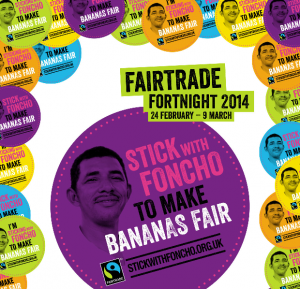
Fairtrade Fortnight (24 February – 9 March 2014) marks the launch of a special campaign that aims to transform the banana industry. It is a campaign initiating the movement Make Food Fair.
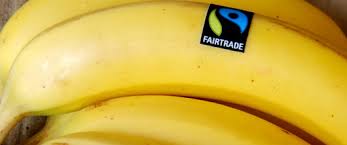
fairtrade bananas

To support the Fairtrade Fortnight everyone can pre-order event packs, stickers, T-shirts, ethically sourced bananas suits and inflatable bananas. Moreover, there is free access to recipes, quizzes, presentations and a media toolkit.

The University will be participating in Fairtrade Fortnight, and if you would like to get involved please email sustainability@gre.ac.uk!
stick with foncho