Carbon Saving at the NRI Glasshouse and Insectary

Today Charles Whitfield from the Natural Resources Institute tells us about how they are contributing to carbon saving at the University of Greenwich through upgrading and updating the glasshouses and insectary:
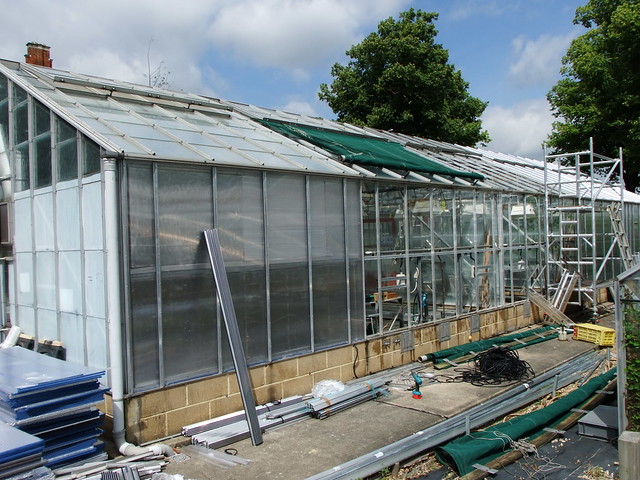
Progress on the Glasshouses

Progress on the Glasshouses

Over the last few months the NRI and Facilities Management in conjunction with the University of Greenwich Sustainability Team have made some huge improvements towards reducing energy consumption in our glasshouses and insectaries. The glasshouses were installed over 20 years ago. Although they were built to a very high specification and have lasted well, they have been due for an upgrade for quite some time. The recent refurbishment project has involved:

  • Replacing the old 3mm glass panes with tri-walled, high insulating, polycarbonate sheets (24 – 40 % reduction in heating cost). (For the heating geeks, 3mm glass has a U-value of 5.9 and the new polycarb had a value of 3).
  • Installing new doors with better insulation and seals.
  • Adding light sensors to the hi-lux sodium lamps so that can come on automatically if natural light is too low.
  • Removing the FCU heaters from the ceiling which will vastly reduce heat wastage via open ceiling vents as well as allow more natural light into the compartments.
  • Upgrading the control systems to link the heating and cooling systems so that they work together (rather than individually as before).
  • And finally, preventing the disruption of research and saving precious time and energy, we have replaced all the insect screens to reduce incidences of pest outbreaks in the compartments.
  • Improving online BMS access for the glasshouses so they can be monitored and controlled remotely by NRI technicians

At the same time we have also installed new hoses and water guns to reduce water wastage, and work will soon start on repairing and repainting the floors. In addition, the cleaners spent several sweltering days scrubbing 20 years of limescale from the internal glass partitions.
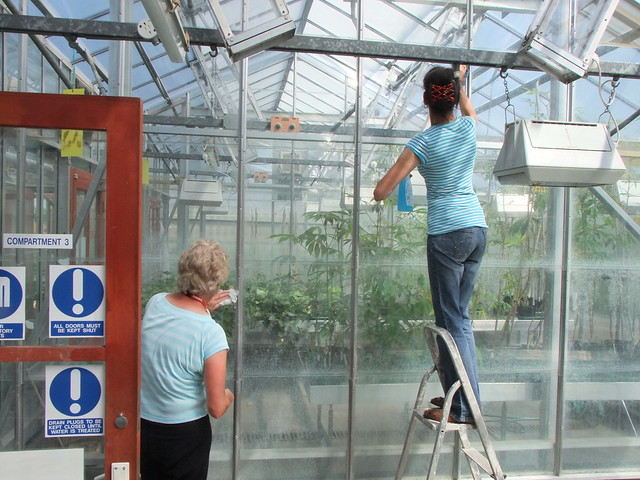
Cleaners working hard at making the glass see through!

Cleaners working hard at making the glass see through

Energy consumption in the insectaries has been reduced by a number of upgrades to the control systems and ceiling lights. We now have the ability to ‘shut down’ rooms that are not in use. Energy efficient fluorescent lighting has been installed in rooms that originally only had high energy lighting. This allows us to switch over to the energy efficient lighting if the room is not currently being used to grow plants. Not only does this reduce energy consumption by the lights but also reduces the amount of cooling required in the roof space (the high energy lights produce a huge amount of heat). Manual light switches have been added to all the CT rooms in the insectary as well as the EAG room, and post room (so the lights no longer need to be left on all the time).
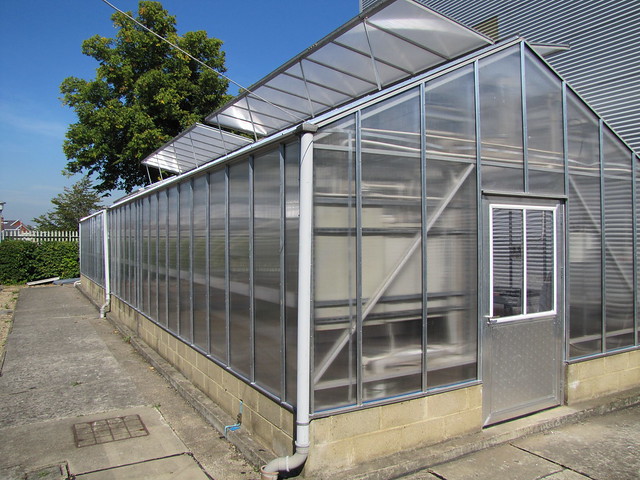
The finished glasshouses

The finished glasshouses

Overall, these improvements should provide a substantial reduction in energy consumption by the NRI facilities and give users more control of their workspace.

The Sun is Shining on the University of Greenwich

With the weather being dark and windy these last few days you may have thought it an odd title for this week’s blog but I must tell you about our brand new solar array!

Last month the University of Greenwich installed an array of photovoltaic solar panels that will be powering some of the student residencies at the Avery Hill Campus. The panels have been installed in time to benefit from the higher rate of the feed-in-tariff before the incentive was reduced in December. They now have been generating electricity for four weeks (at a time with the shortest amount of daytime) and have so far generated: 1,106 kWh this has given the University a combined total saved/earned of £485. On top of this the electricity generated is enough to power five student flats for a week in Aragon Court, (electricity, heating, hot water, the lot!) and all in the gloomiest weeks of the year.

Panels being hoisted onto the rooves at Avery Hill

The completed array on Aragon Court

The panels have a lifespan of around 25-30 years and will be generating electricity for free as long as there is daylight. In fewer than ten years the panels will have paid for themselves and then after this point they will be generating an electrifying profit!

In fact the return on investment for solar is so good that we have seen a few people putting up arrays on their private property. Jon Hudson of the Building Services Team has a small array of 6.5 kW on his house and when John Bailey went back to the west country for Christmas he noticed his mum had popped five panels up on the roof there – not quite the 190 odd we have up on Avery Hill but enough to turn the meter backwards when all the lights are off.

Kevin Behn from Human Resources, who is currently looking forward to starting work on his new allotment and getting on with some D.I.Y, has recently installed some solar panels on his house – and just in time to receive the maximum feed-in-tariff rate. Kevin has managed to get eight panels on his roof, an array that should produce around 1700 kWh per year, and is expecting to see the panels pay for themselves in eight to nine years, after that he still gets the feed-in-tariff for a further 16-17 years and any electricity generated then will be producing a profit. Kevin added a cautious ‘wait and see’ on his estimations but said that he ‘is more than staisfied’ with the panels so far. Like Kevin we’ll be hoping for a sunny 2012 here in the Sustainability Office and hoping that everyone’s solar panels perform as well as we’re predicting!

For those who are interested in finding out more about solar power and generating electricity and energy from renewable sources, the School of Engineering has a solar array consisting of five varieties of panel at the Medway Campus. The School have been testing the panels to see which ones produce the best yields when harvesting the sun’s energy. You can see the panels when you wonder up to the Wolfson Centre and can find out which panels you should be choosing more by contacting Ian Cakebread at the School.

Solar Wall of different panels at Medway

Launching in the next academic year is a new course that covers solar power along with a whole host renewable and sustainable electrical energy generation with the BEng Hons: Sustainable Electrical Power Engineering. This course will give graduates the necessary skills and attributes to take key roles within industry as professional engineers and give them an advantage in the growing clean energy sector. If you would like to find out more head to: http://www2.gre.ac.uk/study/courses/ug/eleng/suseleceng