4th July Work Day

While the summer struggles to settle in and the sun is very shy, our garden in Avery Hill is looking good and flourishing with vegetables! We finally see (and taste!) the results as we keep on harvesting the abundant products from the raised beds.
our beautiful garden!

The plants must feel slightly confused with all these weather extremes, with moments of sturdy sunny heat followed by long pouring rain: the rocket for example couldn’t resist and bolted we had to remove all the flowers!

the rocket flowers as they bolted

However some other plants are doing very well, such as the peas – looking gorgeous!
our pea bush!
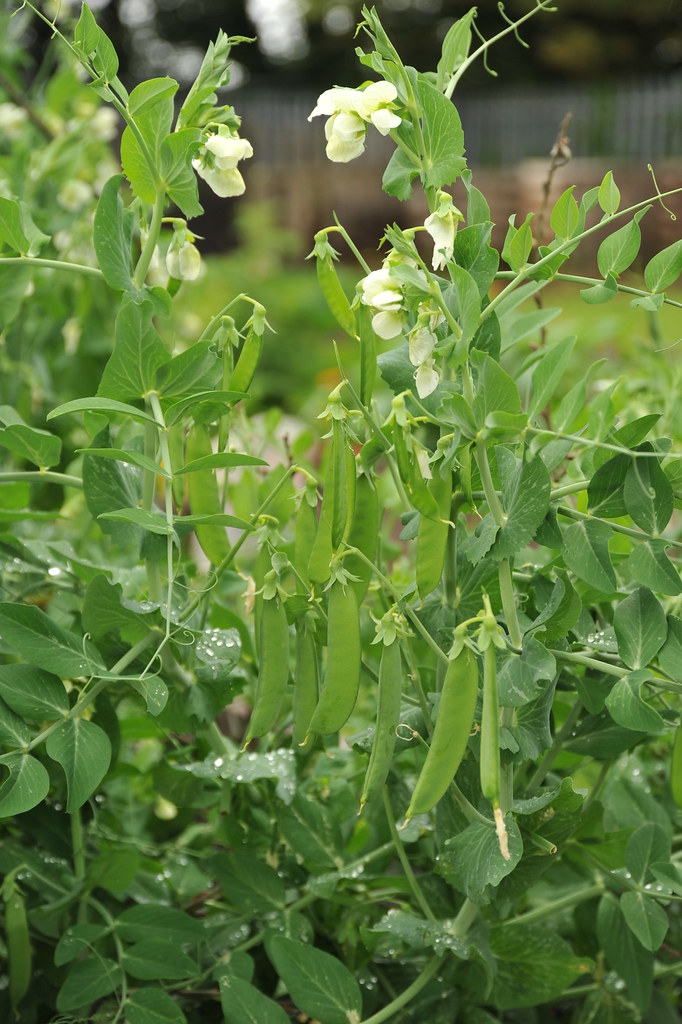
lots of peas!

Radishes are growing full of flavour and massive in size

Jon with the radishes

Also the lettuces, Swiss chard and spinach are thriving with abundance in their beds; the brassicaceae (the Cabbage family) bed is also looking very happy with beautiful cabbages and lovely kale (the very Italian Cavolo Nero).
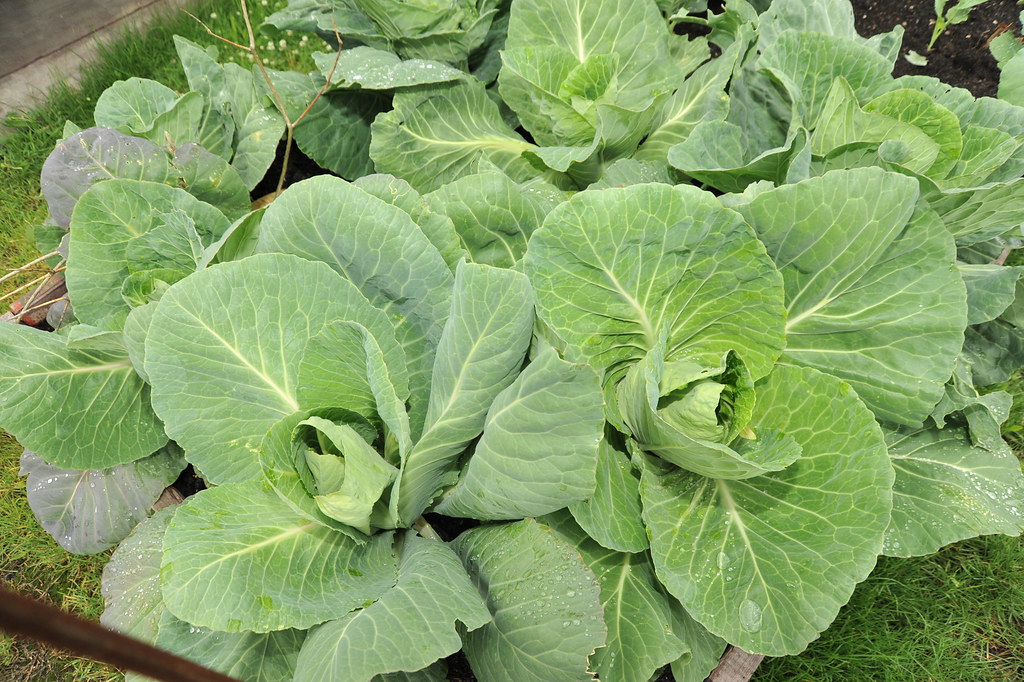
wonderful cabbage

In the meantime, the first tiny tomatoes, marrows and beans made their first appearance and are joyfully getting bigger (yummy!) I’m looking forward to taking my first bite!

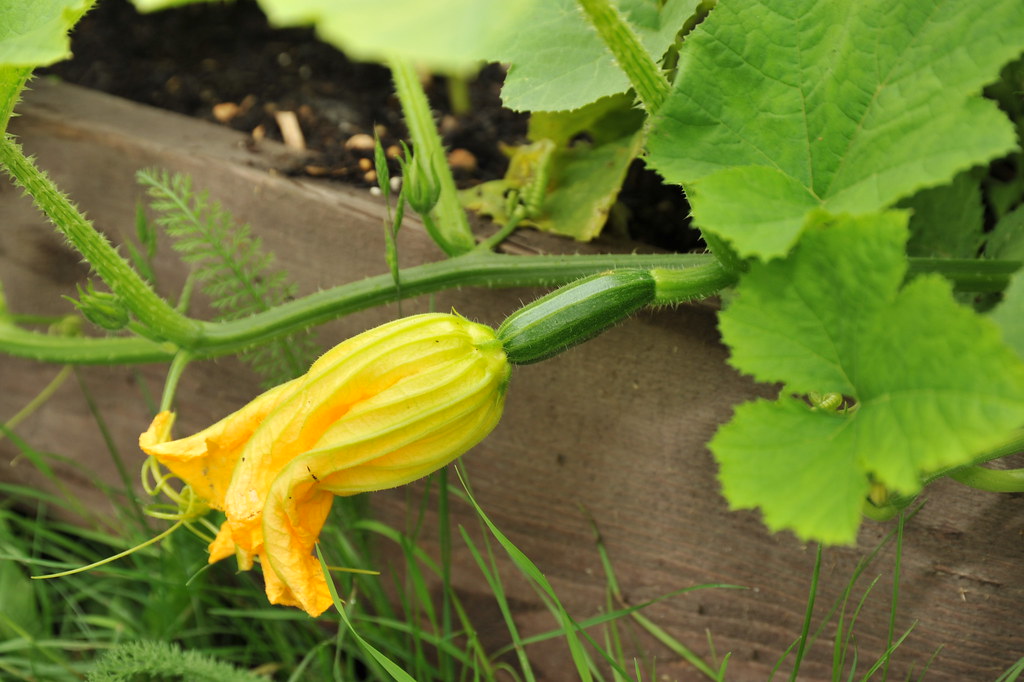
tiny courgette growing
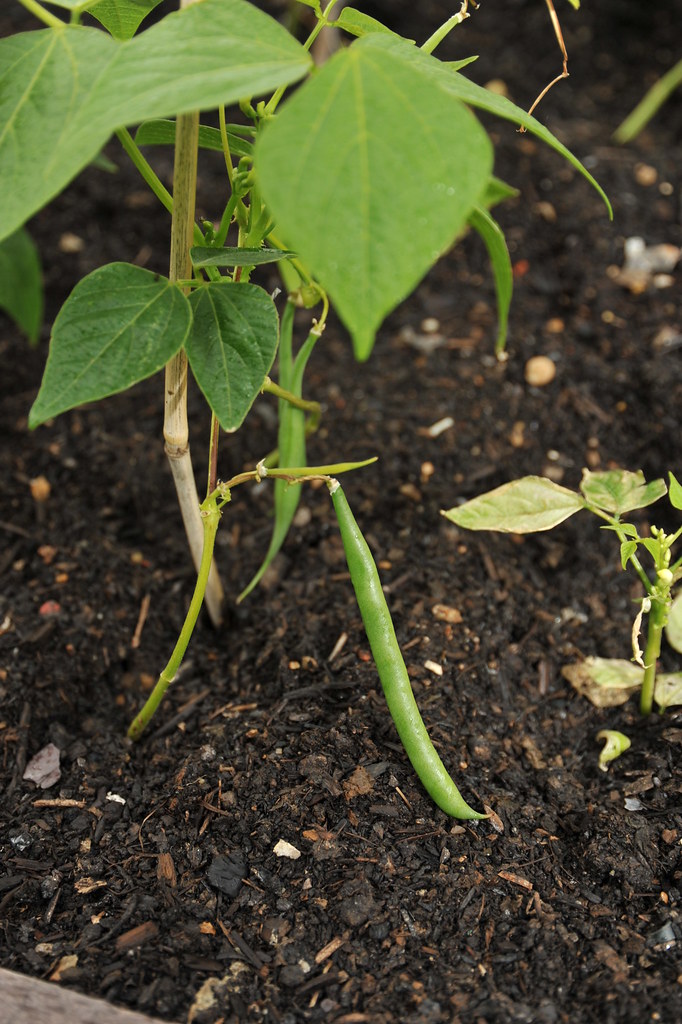
our first beans!

Last Wednesday we had a very nice full day of work and achieved big results. The toughest one was moving the mountain of compost from the upper side of the garden down to the compost area. This required a good amount of passion and muscle power, happily donated by our own very strong men James, Julian and Stefan.

While we were all working very hard, this tiny lost frog came to visit:
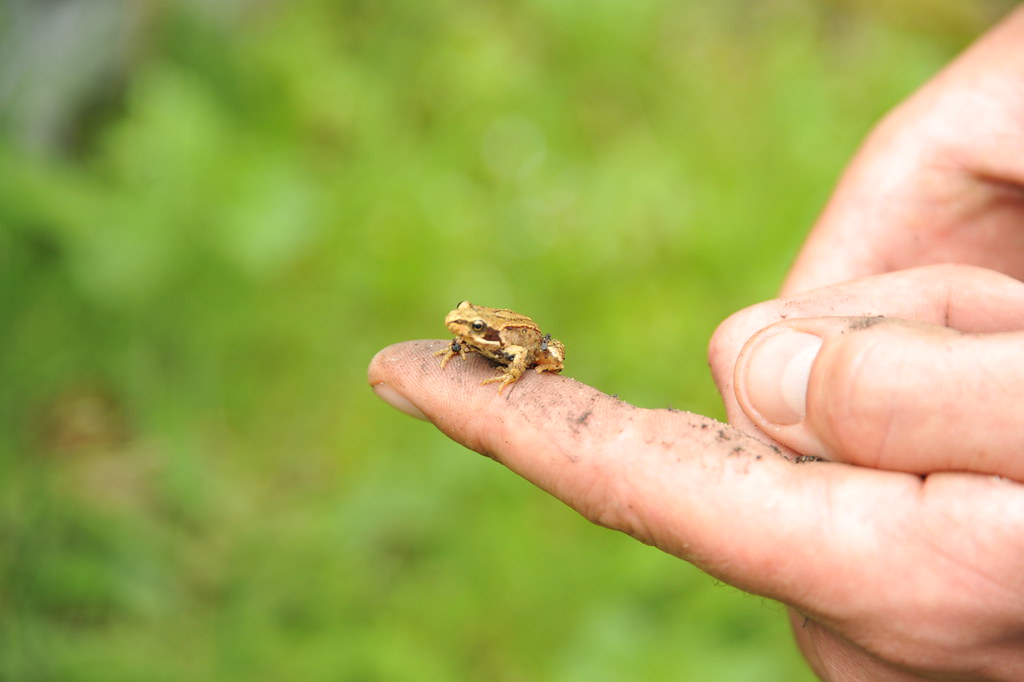
unexpected visitor

Other tasks involved clearing the beds from the weeds that had peeped out from the ground since last week – such as yarrow and fat hen. These are very common weeds that can grow spontaneously almost everywhere and – although can be annoying if you didn’t want them to be there – can be edible and useful. Fat hen for example tastes nice if eaten raw in salads or cooked in tasty risottos; yarrow flowers can be used in infusions against hay fever and are also important source of food for beneficial insects.
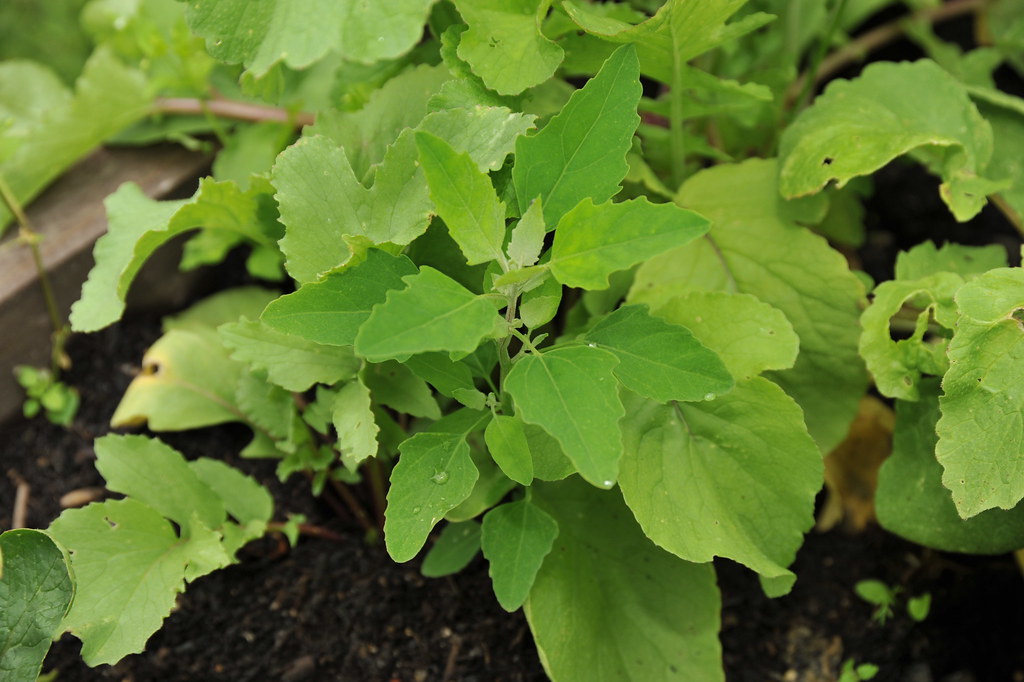
fat hen with radishes
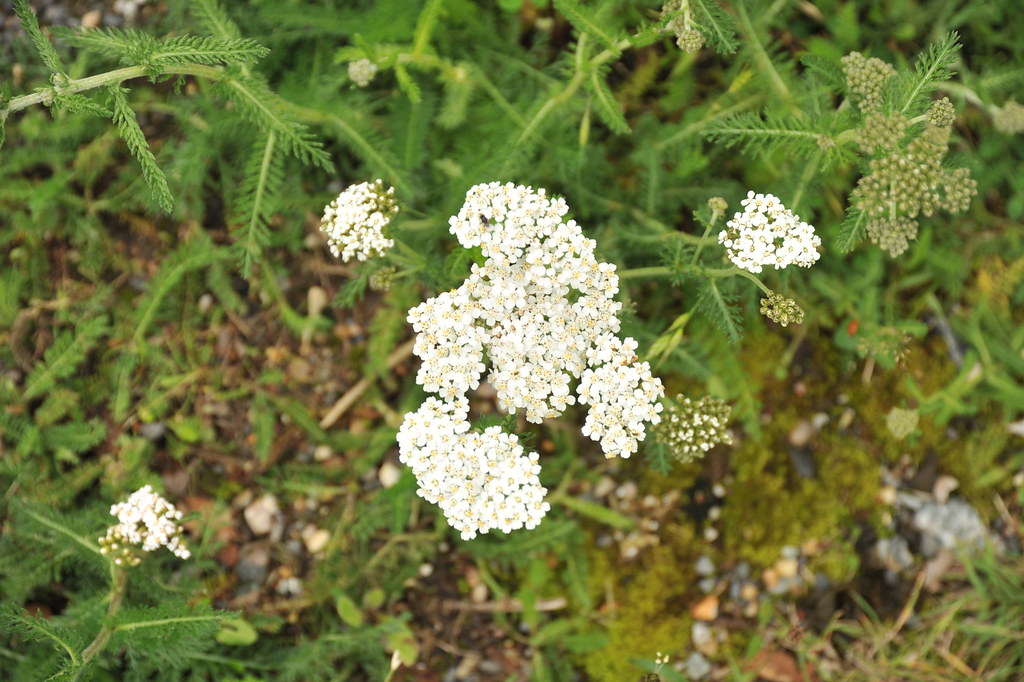
scented yarrow flowers

We carried on transplanting some tomatoes seedlings in one of our solanaceae & cucurbitaceae beds (potato and cucumber families) where also courgettes and aubergine are now growing. We also planted giant sunflowers in the corners of different beds and next to their cousins the Jerusalem Artichokes. These sunflowers will soon look spectacularly tall and will make great companion plants as aphids love them and hopefully will hang about up there, leaving our lovely crops alone, for us to enjoy!

The favourite job of the day was to prune the tomato plants as the smell was so nice! Pruning tomatoes is very easy and extremely beneficial to the plant as it will increase fruit size and quality, while also reducing risks of diseases. The basic method of pruning is to remove the lower leaves at the bottom of the plant and the suckers that grow from the leaf axils, you do this by pinching them with your fingers every 7-10 days throughout the growing season.
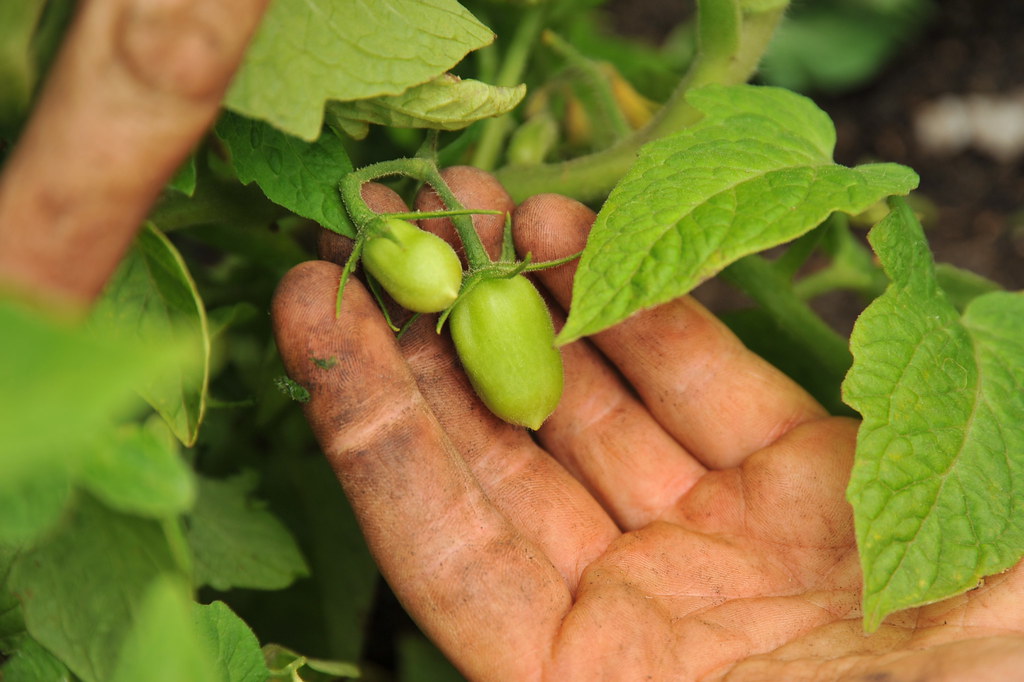
the first tiny growing tomatoes!

The less pleasurable task instead was moving the stinky pile of organic matter (mostly grass residues) from the first compartment to the second one, this was bravely carried out by me and Stefan in turns. The key to make good compost is to use a mixture of ingredients: young, moist materials, such as grass clippings, known as “greens”, rot quickly resulting in an unbearable smelly sludge; this is why they need to be mixed with tougher, dry items like old bedding plants – “browns” which add the necessary fibre and a supply of air to give the compost a good structure. These can also be scrap papers and packaging like paper bags or cardboard for example – to provide a good balance. The compost area is one of the most important in a healthy garden. This is where organic matter is broken down by microorganisms and other little creatures, like worms and woodlice, which will provide our soil with all the nutrients our plants need.
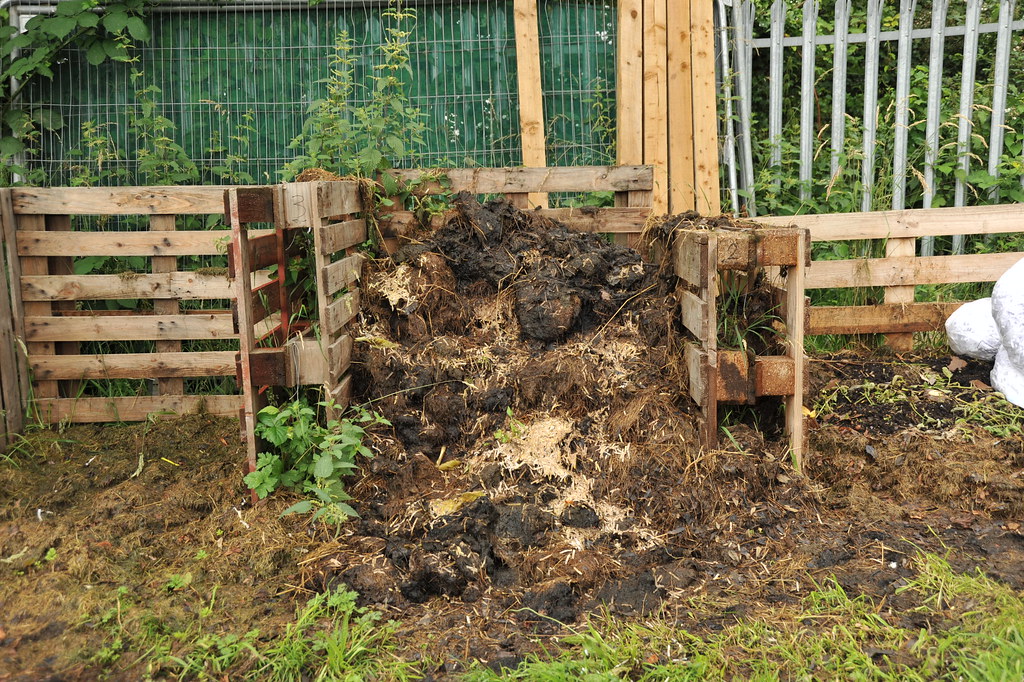
the compost area

There is still a lot to do and to be enjoyed at the community garden so for those who want to practice their gardening skills or simply have a breath of fresh air on those working days, come along and join us! We are here every Wednesdays!
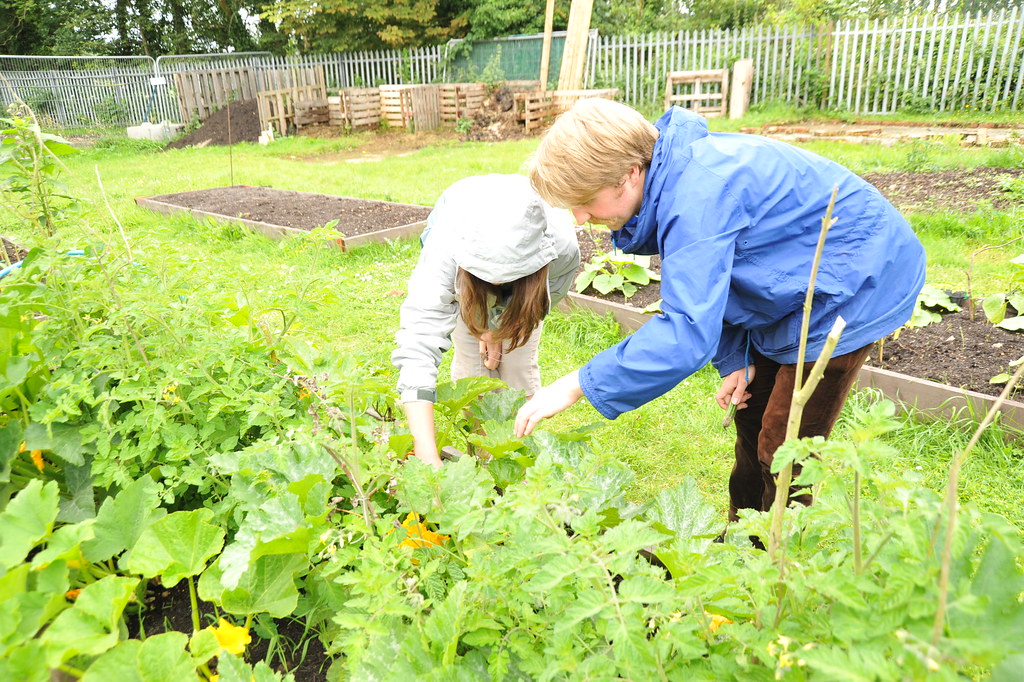
our very own special gardeners, Jon and Kat, checking on the vegetables
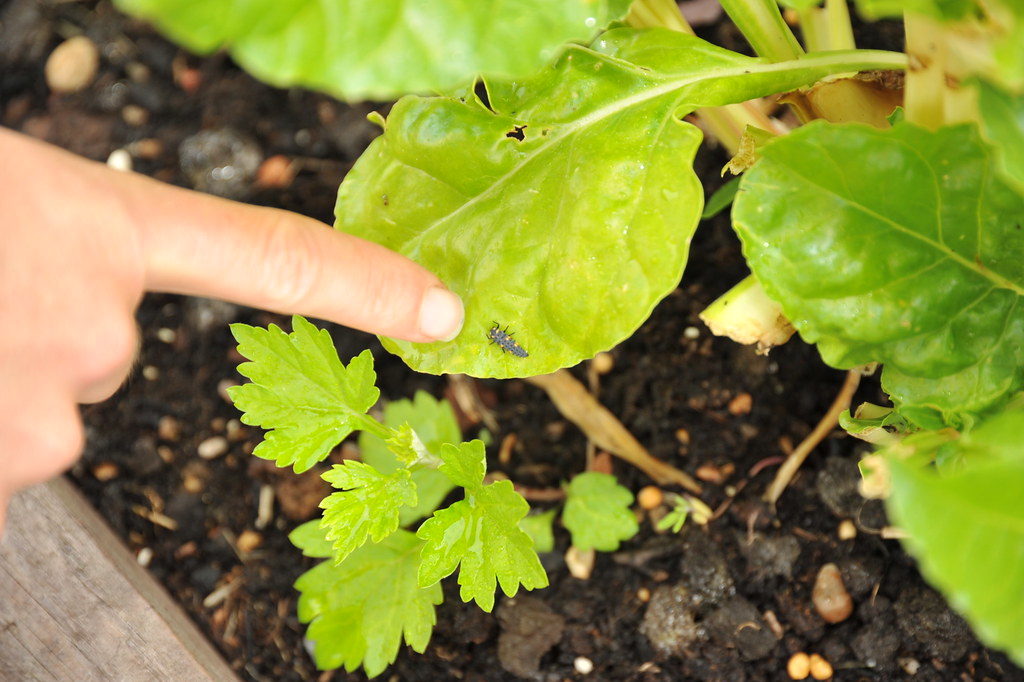
the gardener's best friend: a ladybird larvae

Community Garden at Avery Hill Campus

It has been an exciting past few weeks at the Avery Hill Campus as the community garden allotment has started to take shape. The garden now has eleven raised beds built, four of them filled with compost, a line of compost bins ready for our waste and a huge pile of compost donated from CJS Plants who occupy the (plant) nursery on the Mansion Site.

We have managed to achieve this in just four work days and the hard work of 25 staff and student volunteers! The garden is very much still in its early stages, and we still haven’t actually planted anything yet but the good news is we will be starting that on Wednesday.

We are going to be joined by Capital Growth who will be taking us through the basic skills required for looking after a community garden and showing us what to plant, how to plant it, when to plant it and where to plant it. We will be taught about companion planting and how certain species of plants work as well together in the vegetable patch as they do in the soup pot! Of course everyone is welcome to come along whether you are a student, staff member, friend, relative or just curious – we will be at the garden from 12noon – 6pm. Email: sustainability@gre.ac.uk to find out more.

The first work day saw ten of us uncover a shot put circle, reveal the base of a burned down shed and build the compost pens from pallets that had been recovered from around the campus. The shot put circle is a legacy from sports fields that used to be on the site, last year we removed the hammer throw to make room for our orchard! The end result can be seen below:

Compost bins built from recycled pallets

The following work day we then focussed towards getting some raised beds built, using second hand scaffold boards salvaged in East London and wooden posts we were able to start constructing the beds. The raised beds are being treated with a non toxic wood preserve which means the beds should survive through the wet weather without starting to rot and break up – the non toxic preserve is chosen specifically to make sure that any preserve leaching into the soil is harmless to any plants and vegetable being grown. The method for building is very simple – driving four coach screws through the boards and into the posts at each corner and while we have made the best effort to make sure the corners are at 90 degree angles apparently the vegetables won’t mind the eccentricities that we may have created!

Constructing the first raised bed

The beds have been set straight on top of the ground and are starting to be filled with compost. The compost will block off the light to the grass below meaning it will die off and start to rot and become part of the compost too. As the beds get worked on and the vegetables grow the soil and nutrients below ground level will eventually become part of the soil the fruit and vegetable plants will be growing into. This means that while the beds may appear quite short and as though you wouldn’t be able to go particularly deep the vegetables and roots of the plants will in fact be going below the ground level.

Loading the compost from the truck into the bed

We are now at a stage where the last few beds need to have the wood preserve painted on them and the rest of the compost beds need to be filled with the compost we have on site. The four of them that are already filled just need some seeds and seedlings planted into them and then for nature to work its magic!

Raised beds ready for filling, painting and planting!

New Orchard at Avery Hill

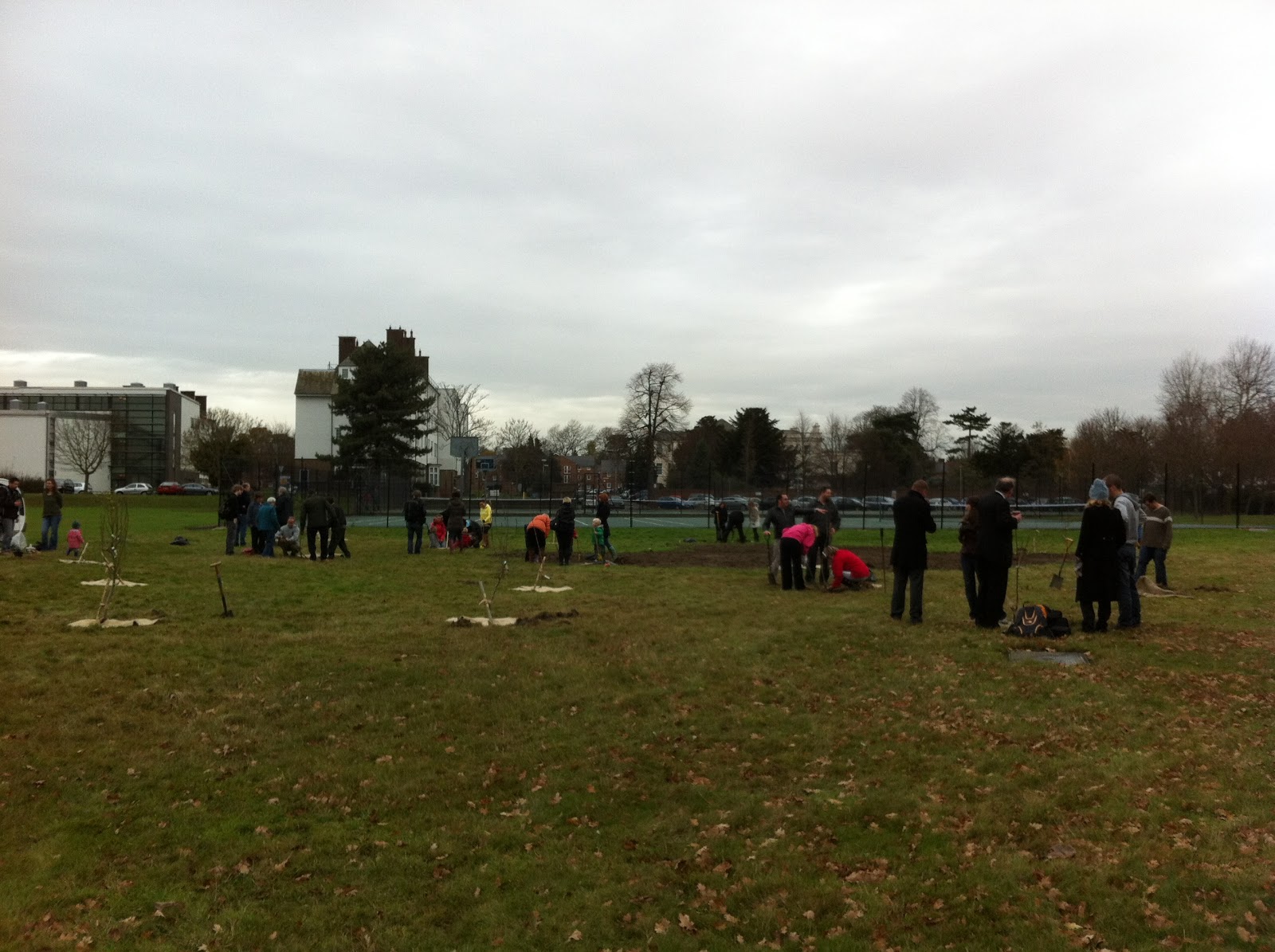
Today staff, students, local residents, graduates, friends, family, children and a member of parliament came together to plant a community orchard at the University of Greenwich. At Avery Hill Campus a huge group of volunteers (and a couple of experts from the London orchard Project) took a break from their regular working day to get their hands dirty and plant one of 20 fruit trees in the new community orchard.

The orchard will be supplying staff, students and local residents with a tasty array of fruit (apples, pears, medlar, plums, cherries, damsons, mulberries) for coming decades! It has come as a result of a partnership between the University and the London Orchard Project, who are creating new community orchards in London’s unused spaces to promote community production and ownership of fruit. Plus of course helping us rediscover the pleasures of eating fruit grown close to home (or work). These community orchards are contributing towards the ‘greening’ of the urban environment and are creating new and enhanced habitats for wildlife – especially true at Avery Hill where the orchard will be surrounded by long grass and wildflowers which will be great for encouraging bees, insects and the predators of pests such as aphids and codling moths.
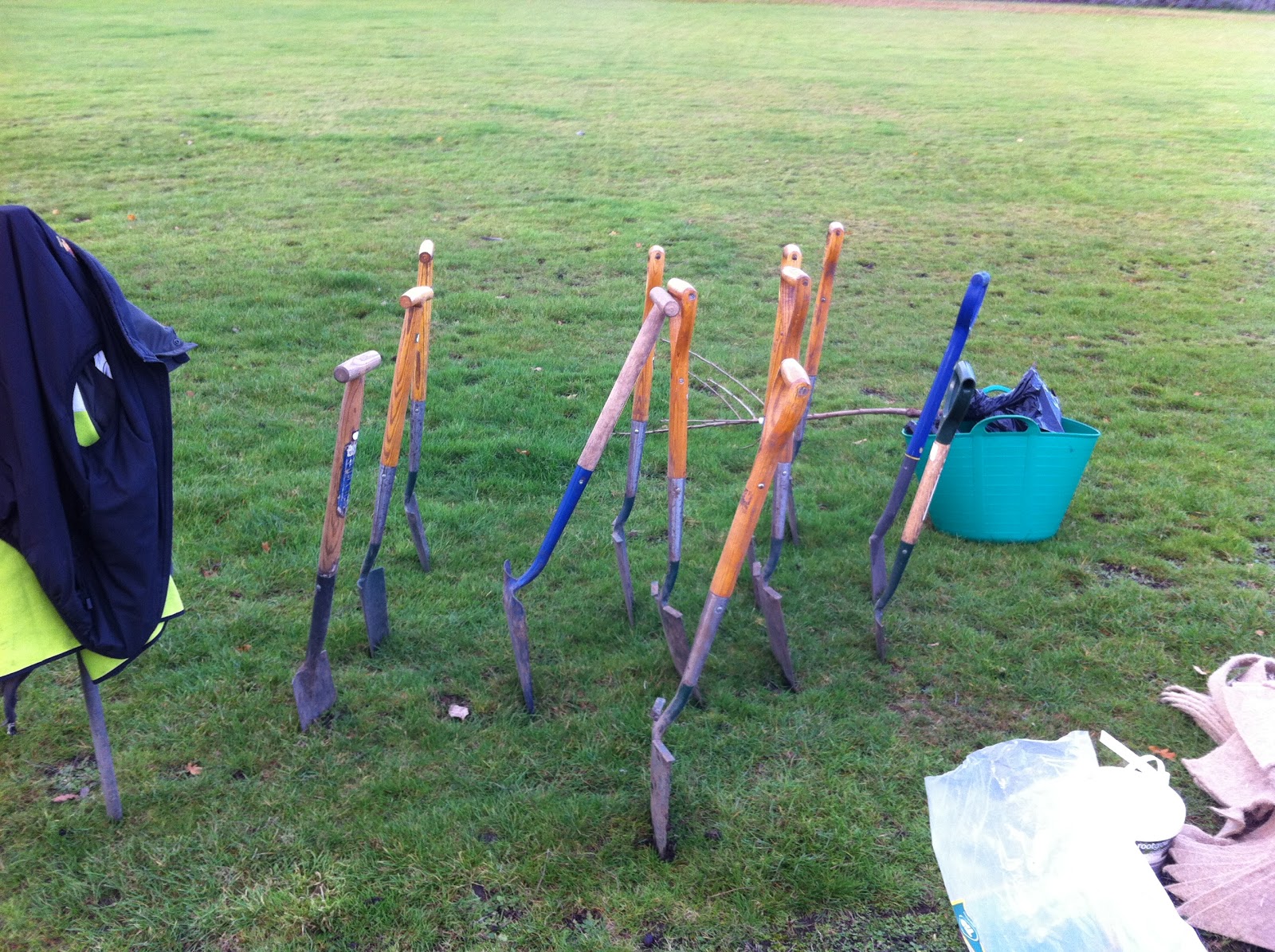
A dozen spades prepare for the digging

The orchard planting is part of a wider University push to improve and enhance the biodiversity on campus and promote local food. The majority of trees have been chosen to fruit during University term time and after three years some of the apple trees will be producing about 300 apples per crop. Students at Avery Hill will never need to buy an apple again!

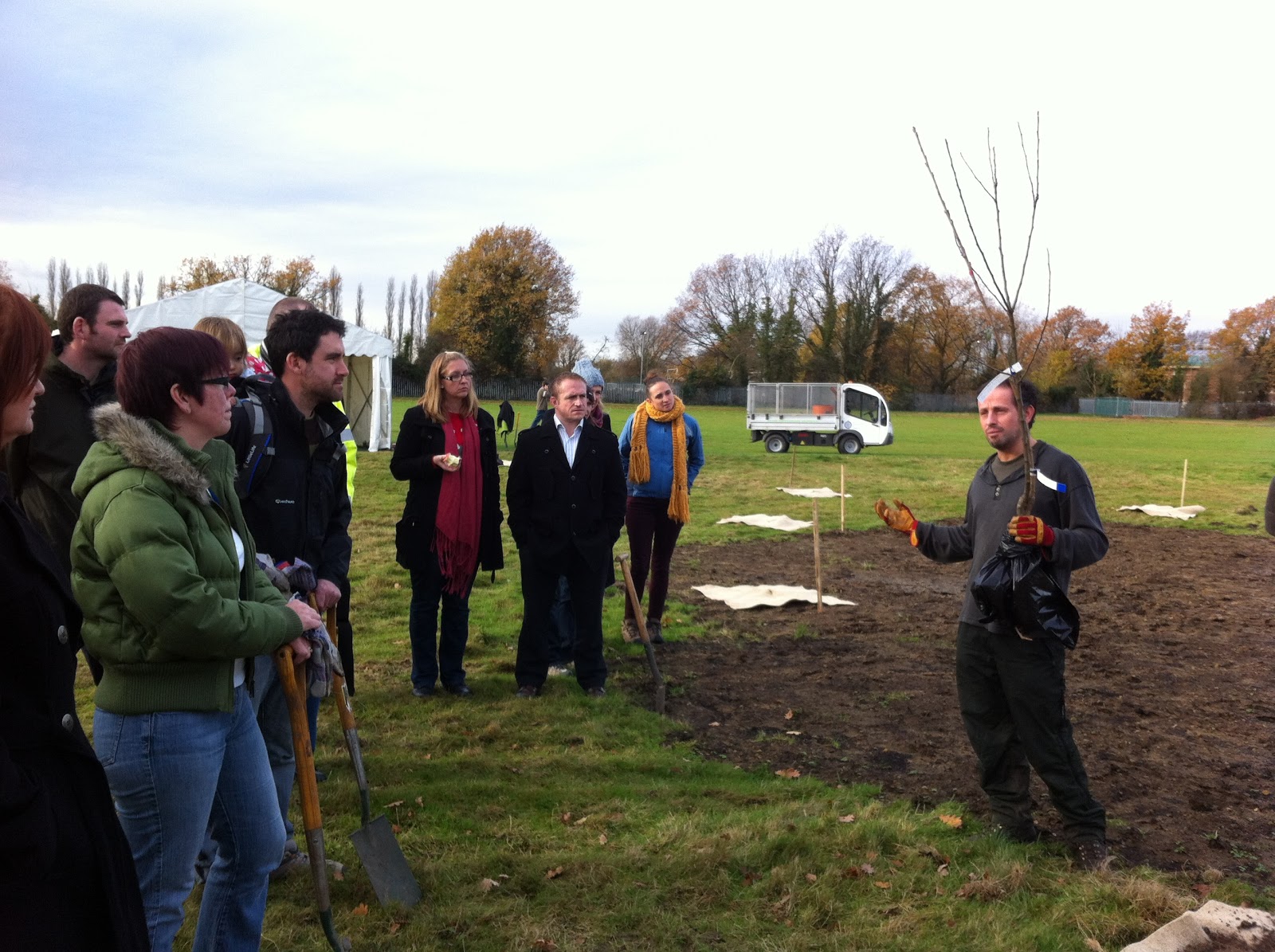
Russell from the London Orchard Project teaching the volunteers how to plant a fruit tree


Claire Evenden, who came with her colleagues from the Student Records, planted an apple tree called a ‘Fiesta’, said she was looking forward to watching the tree grow from her window in the Bronte building.
Paulina Bush from the University of Greenwich nursery came along with a dozen children who planted two of the apple trees (Discovery and Pinova) with the spades they normally use for maintaining their forest garden. Paulina said that the children would be coming back to the orchard regularly to water the trees and of course help harvest the fruit as well!


The volunteers digging away and planting the trees

 The plan is not to stop at just an orchard either. Close to the orchard we have a space on the Southwood Site where work is about to commence on a community allotment and forest garden, with plans for a nut orchard (or is that a nuttery?), a vineyard and hops also being considered for future food growing projects. Of course if you would like to find out more about any of the food growing projects or indeed get involved with the allotment and forest garden please email us at: sustainability@greenwich.ac.uk

Here is a complete list of the 20 fruit trees planted on campus today:

 
Apples:
1. Egremont Russet. Late Victorian English variety, most important commercial Russet, a hardy variety with a nutty, sweet flavour ripe in late September. Originated in Sussex in the early 1800s.
2. Falstaff. Very good disease and frost resistance, crisp and juicy red desert apple, ripe late September
3. Tydeman’s Late Orange. Variety raised in 1930s in Kent, rich aromatic flavour, firm and sweet, orange to red in colour, picking time mid October. A cross between a Laxton Superb and a Cox Orange Pippin, but a lot easier to grow than a Cox Orange Pippin. Picking time mid-October
4. Tentation. New variety, yellow to golden fruit, picking time late September and stores until March
5. Greensleaves. Green to yellow mid-season apple, tasting a bit like a Golden Delicious, picking time mid-September. We think this apple is essential due to the Henry VIII theme it shares with the campus buildings. Fruits mid-September.
6. Fiesta. Another Cox-like apple but hardier. Heavy cropping with brightly coloured, aromatic fruits, picking time early October.
7. Pinova. A hardy tree with Cox and Golden Delicious as parents. The fruit hangs late on the tree and stores well. Harvesting time late September.
8. Discovery. Bright red, crisp, juicy with a sharp fresh flavour. This is an early apple (early August) so will provide fruit for staff/ any students on campus over the summer.
9. Bramley’s seedling. The classic British cooker, grown from seed in a garden in Nottingham, the original tree is 200 years old and still going strong. Creamy white flesh, full of flabour – though there are alternative cookers if you want something more unusual. Also makes lovely sharp juice.
10. Howgate Wonder. A cooker that can also be eaten/ juiced when fully
ripe. Pale green with brown-red flush, fruits early October.
Pears:
11. Doyenne du Comice. French pear grown from seed, first fruiting in 1849. Reached England in 1858 and soon became very popular for its delicious flavour and jucy texture. Picking mid-October.
12. Williams Bon Chretien. Pears known to the Romans, considered by the best pear in the 16th century. Raised by a schoolmaster in Aldermarston near Reading in 1770. Needs to be eaten off the tree in September as does not store.
13. Concorde. A reliable, heavy cropper with melting, juicy flesh. Picking time late October.
Plums and other stone fruit:
14. Marjorie’s Seedling. Excellent late plum (picking time late September). Oval-shaped purple fruit with yellow flesh.
15. Victoria. A classic plum, discovered in a garden in Sussex and named after Queen Victoria. Picking time is August so another fruit for staff and summer-students to enjoy.
16. Shropshire Damson. A hardy damson with some plum-like characteristics. Best used for cooking and has a rich flavour but can also be eaten from the tree if left to ripen. Picking time late August / early September.
17. Cherry Early Rivers. One of the earliest cherries, with very dark skin and flesh, and excellent flavour. Produces a heavy crop, ready for picking in mid-June.
18. Cherry Stella. Juicy dark-red cherries, ready for picking in late July. Fruiting time isn’t ideal for students but it does make a good pollinator for other cherries.
Other fruit:
19. Medlar. A beautiful, squat and spreading tree with attractive blossom. It is also interesting from heritage perspective, being popular in the middle ages and mentioned by Chaucer as being “ripe when rotten”. Picking time is November and the fruits should then be left to decay (blet) before turning soft and sweet.
20. Black Mulberry. A large stately tree that will grow to form gnarled branches and a distinctive form. The fruit is delicious and almost never commercially available. Said to have been introduced in the 16th Century in the mistaken belief that black mulberries harbour silk worms. (In fact silk worms live on white mulberry trees.)

Breaking Ground at our Community Garden and Gearing up for the Orchard Planting

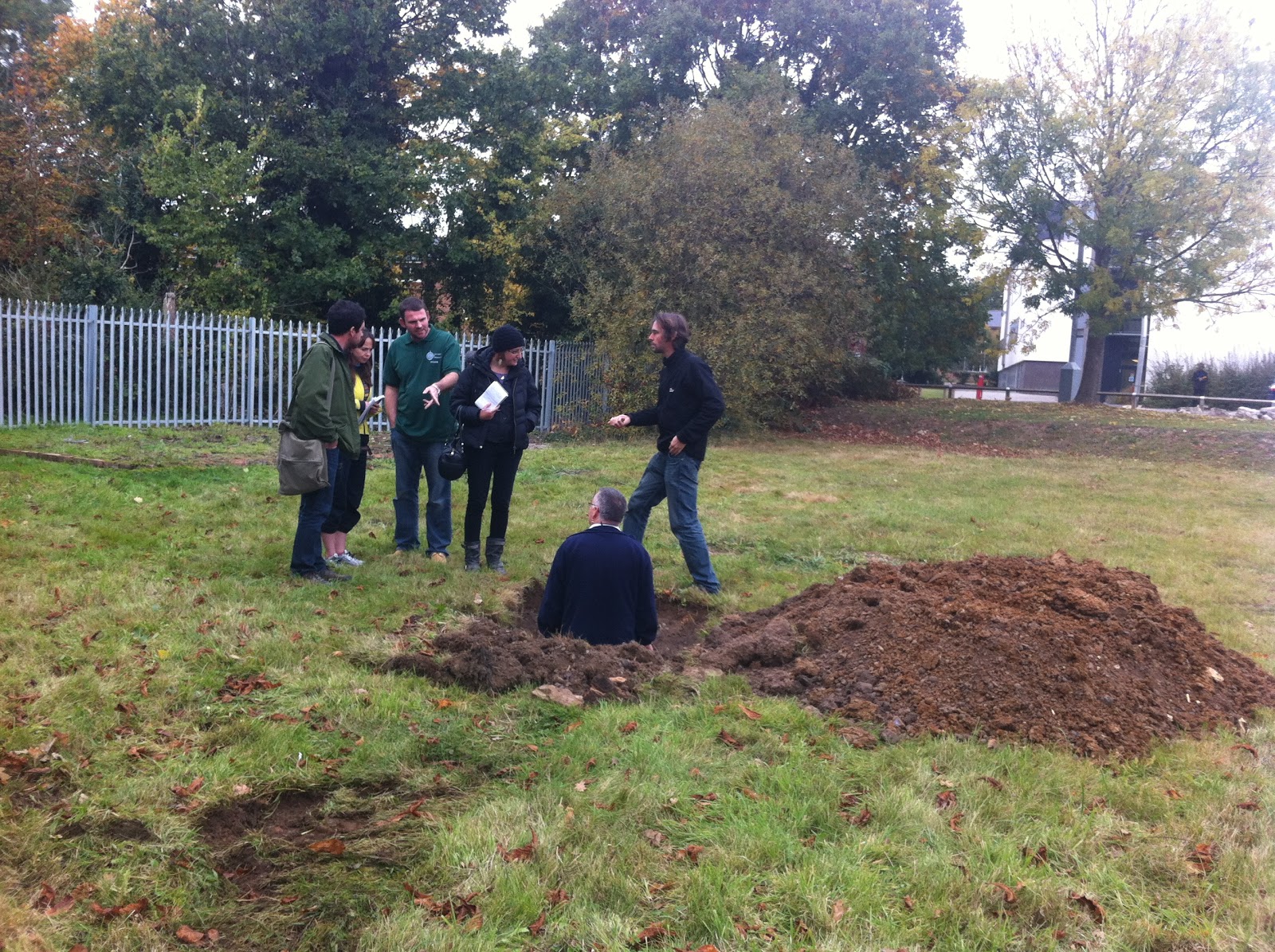
Today the Sustainability Team joined forces with the School of Architecture, James Hallybone and Tom Barnsley from Roundfield and Michael Unsworth from the Grounds team to break ground at the site for our new community garden. We haven’t quite started to dig to plant yet but we have dug one meter below the surface to inspect the soil and get an idea of what the quality is like.

Ducan Goodwin gets into the hole to investigate the soil

So what’s it like then I hear you cry? Well, just below the surface there is a fair bit of rubble – not too much though, then after that there’s some well drained soil a few pebbles and gravel and then the clay. The School of Architecture first year garden design student will returning to the site to do some more robust testing over the coming weeks but certainly the first look is positive. The soil may not be of an award winning standard it is certainly good enough that we can get a bit of compost mixed in and start digging and planting when the time is right.

Looking at the different layers in soil

We are now looking for students, staff members and locals who are interested in getting their hands dirty and getting involved with either the design, building of, maintenance and growing in the garden. If you are interested please email: sustainability@greenwich.ac.uk

Sticking with the theme of growing your own, we are just one month away from our orchard planting at the Avery Hill Campus. On the 1st December this year we will be planting 20 trees including ten varieties of apple, three varieties of pear, two plum trees, two cherry trees, a damson, a medlar and a mulberry tree. The orchard will need staff and students to adopt a tree for watering, pruning and a little bit of care, particularly for the first two years. Not to worry if you don’t have any experience in managing orchards for the London Orchard Project will be offering a training session telling you exactly how to look after a tree through its early years. Once again if you want to be involved in the planting of and adoption of one of our trees please email us at: sustainability@greenwich.ac.uk

Seeing as its Halloween this Monday we have a few little interesting links that we’ve noticed come up today. Firstly over at Planet Pals they have a nearly endless supply of ideas for a green Halloween: http://planetpals.com/green-halloween and Creations by Kara have come up with a great way of recycling an old book into a pumpkin that you will be ablt to use year after year: http://www.creationsbykara.com/2011/09/book-page-pumpkin-tutorial.html

Creation by Kara: Pumpkin book

P.S. Don’t forget to turn the bottles of sloe gin you made last week!

Community Food Garden Plans Afoot at Avery Hill

Today the Sustainability Team ventured up to the Mansion Site of Avery Hill to meet with Robert Holden and the Garden and Landscape Design staff at the School of Architecture and Construction. The topic under discussion was the plans for building a University community food garden. The project will be collaboration between the three schools at Avery Hill (Architecture, Education and Health) and staff and students who work and live on the campus to create a space where they can grow fruit, vegetables, herbs, salads and whole manner of delicious treats.

Statue in the Winter Gardens at Avery Hill Mansion Site

With assistance and advice from Capital Growth and the Greenwich Co-Operative Development Agency the plans are afoot to create a space that will not only provide food but could also double up as an outdoor learning space, social area and a sensory and medicinal garden. Using inspiration from the ideas of permaculture design we are hoping to reuse and upcycle a number of items located around the campus including tyres, pallets and an unused gazebo.

The garden will be set-up on the Southwood Site, just south of the sports hall which is also where the university is planning on planting an orchard later this year. The orchard is being designed by the London Orchard Project who are trying to create a ‘fruit tree revolution’ in London by promoting the virtues of home grown fruit and planting new community orchards all across the capital. We have earmarked the 1st December as the day to start the tree planting and will be hoping to round up a good few staff and students to get stuck in and involved with the planting.

When the orchard is planted it will not be the only source of fruit on campus as the sustainability team has discovered over the past 18 months there is already a lot of fruit hidden away in the nooks and crannies of Avery Hill. Exploring the campus you can find mulberries, blackberries, crab apples, sloes, quince, damsons, plums and as we discovered today even grapes!

Greedy Green Gnome’s Greenwich Green Grapes

The other discovery of the day – and almost as exciting as the grapes – was the website wordle.net. This website converts a body of text into a graphically delightful jumble of multi coloured words. Just look at what it has done to the University’s Sustainability Targets.


University of Greenwich Sustainability Strategy