As a visual artist working with sound, I’ve been exploring how to make audible archives and hidden histories which are rooted in the site-specific. I’ve done this for the last 10 years with the Echoes.xyz audio geo-location platform and through using binaural dummy head field recordings which place my audience inside immersive encounters in order to offer up new ways of listening to historic sites and forgotten narratives.
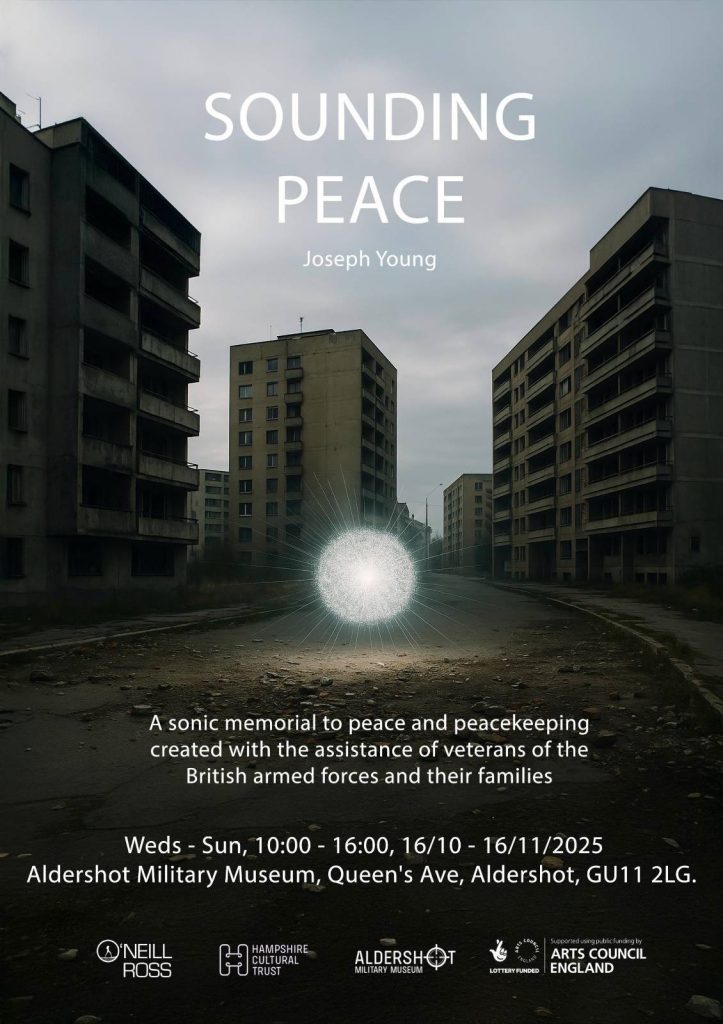
My latest project Sounding Peace centres around conversations with military veterans and their experiences of peacekeeping or peace enforcement missions, and how this has affected their ideas about peace in the world. Interviews with veterans and families took place in person and online, in partnership with veteran groups, museums and military heritage scholars. The aim being to reframe sites of memorialisation (war memorials, museums) through sounding the voices of peacemaking, as expressed by veterans.
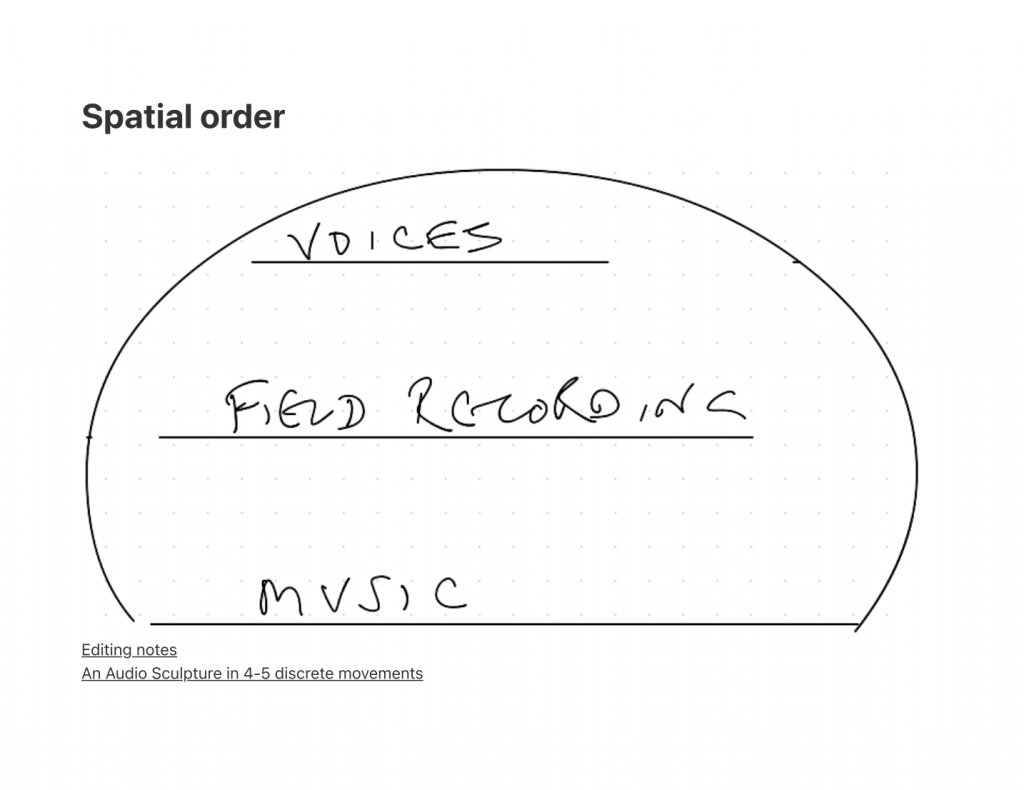
The interviews were transcribed, edited and voiced by AI ‘actors’ to anonymise the initial responses and to add an air of uncanny to the work. Taking Buckminster Fuller’s concept of the geodesic dome as its visual inspiration, the resulting sound sculpture consisted of a multitude of voices arranged in a virtual dome-like structure above the listener’s head, accompanied by ambient musical soundscapes and field recordings layered beneath (see diagram).
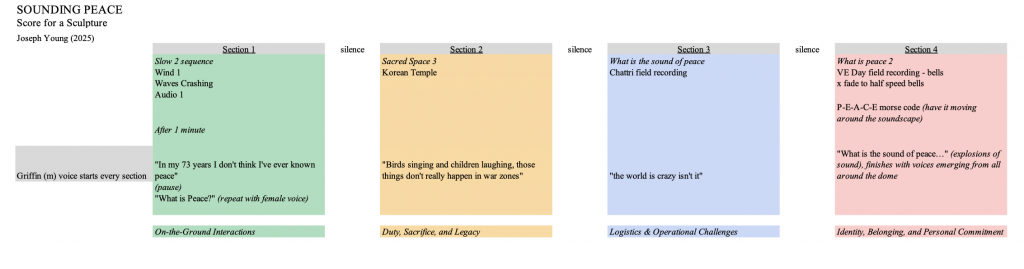
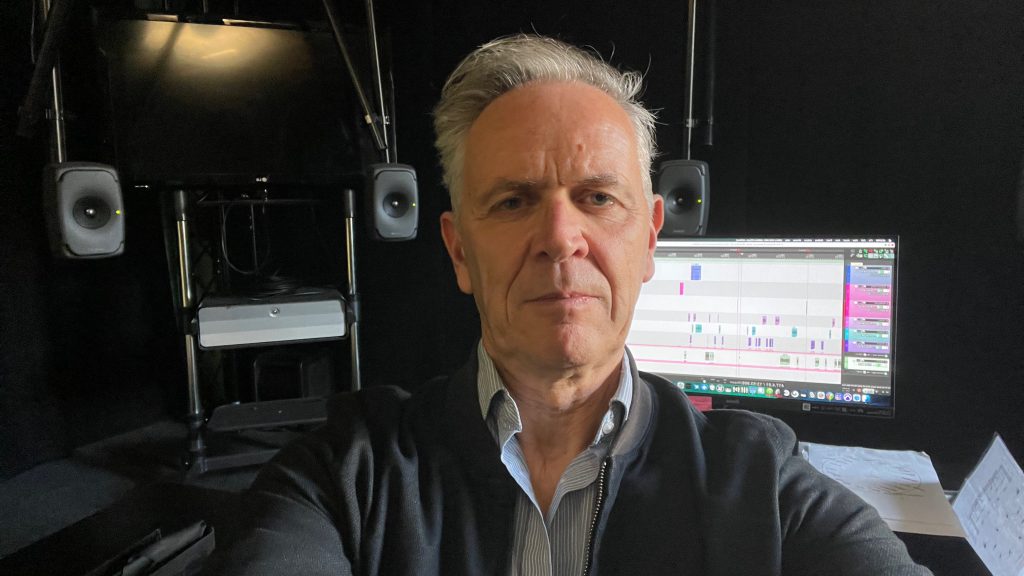
In order to achieve this, I needed to hear the sounds in an ambisonic facility first before transferring them to the virtual environment. The SOUND/IMAGE Research Centre residency offered me three days to spatialise the work. The first day I was accompanied by Dr Brona Martin who patiently guided me through the system, explaining both the tech and offering creative strategies. After this I was on my own, with tech support on call as necessary. Brona also followed up later, when, back in my own studio, I was struggling to translate the work into a headphone-based environment.
The system’s Genelec speakers really are a wonder. I have four of the small 8010A myself, so I was familiar with their characteristic crispness and clarity, but nothing quite prepared me for the sense of immersion possible with this sort of large-scale system. Hours of listening each day did not result in listening fatigue which can often happen in traditional recording studios and I was impressed by how flexible the system is and how much more I now need to learn to be able to fully utilise it as an instrument.
I mentioned about the eventual delivery of the work as an Audio Augmented Reality (AAR) artwork rather than over a traditional speaker based system and this is where there is more work for me to do. The ability to be able to place this artwork anywhere there is a decent 5G mobile signal and gps is an amazing opportunity, but the sense of immersion and the 3D depth and distance achieved in the studio wasn’t quite replicated out in the field. I’ve identified what I think are some of the elements that could help rectify this, but I guess the real learning will come through further iterations, and I look forward to continuing that journey.
Sounding Peace was funded by a Project award from Arts Council England.