
By Maedeh Ahmadi
UGR Hub Project: Capturing Sonic Audiences – The student-led approach
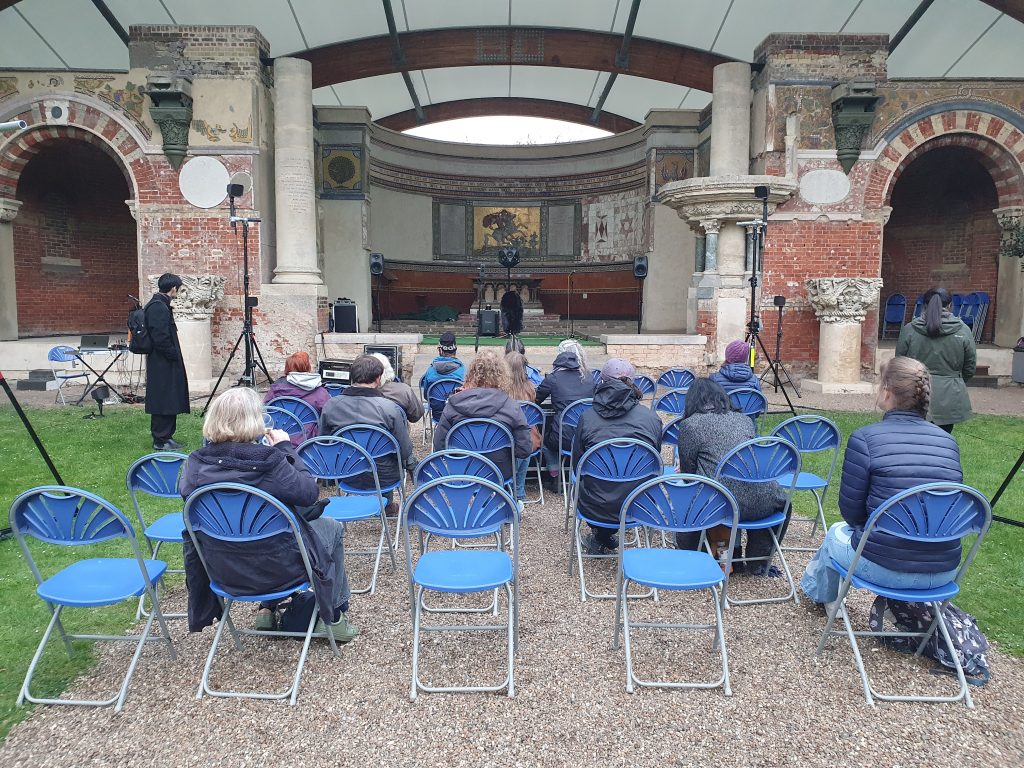
There’s something quietly powerful about hearing music in a place where walls are broken, ceilings are open to the sky, and history lingers in the stone. On the evening of April 23rd, the ruins of St George’s Garrison Church in Greenwich became more than a backdrop, they became part of the performance. Spatial Traces, a concert presented as part of the Loudspeaker Orchestra Series, brought together sound artists, researchers, and an eclectic audience to explore how spatial sound, architecture, and the environment can blur into a single, immersive experience.
I attended the event as both a researcher and a listener, paying close attention not just to the performance itself, but to how people responded to it. What did they hear? How did they feel in the space? And what might this tell us about how to grow and engage new sonic audiences at the University of Greenwich?
As the performance unfolded, what struck me most wasn’t just the sound design -though that in itself was rich, layered, and immersive – but the way people moved through the space. Some stood quietly in corners, letting the sound wash over them. Others wandered, adjusting their position like tuning a radio, searching for new textures or moments of clarity. The space encouraged this kind of exploration, open, porous, unfinished.
After the performance, I spoke with several attendees. Judith, who had travelled from Paris, was particularly moved by the interplay between natural and composed sound. “I liked the mixture of the bells and the music,” she said. “Sometimes you didn’t know if it was the birds or the instruments. Is this nature? Is this composition?” That question captured something essential about the event. The boundaries weren’t clear, and that was the point.
Matt, a regular live music goer but first-time visitor to the venue, told me that the space transformed how he experienced the work. “It felt like the speakers were everywhere,” he said, “and the modest projections really matched the feel of the ruins.” He described the environment not as a backdrop, but as a collaborator, shaping the performance and how it landed emotionally.
Cecilia, another first-time attendee, experienced the soundscape in an intensely personal way. She spoke openly about how the spatial audio and whispering voices brought back memories linked to mental health. “The first part of the concert made me feel very nervous,” she said, “but not in a bad way, just in a way that reminded me of things.” Her comments were a powerful reminder that sound can trigger not only aesthetic responses, but emotional and psychological ones too.
These kinds of reactions – layered, emotional, unexpected – are part of what makes spatial sound so compelling, and what gives it potential for reaching broader, more diverse audiences. Not everyone connects with conventional concert halls or classical formats. But give people an open space, time to explore, and sounds that blur the line between the everyday and the designed, and something opens up.