
Artist Residency August 2024
The Sound/Image Research Centre welcomed Shiva Feshareki to Bathway Theatre, Woolwich to work with our new Digital Immersive Theatre. The new flexible multi-functional performance space for immersion brings together 360º immersive projection, projection mapping, surround-sound audio, with extended lighting, rigging and digital infrastructure. Shiva spent 2 weeks working with our spatial audio technician Liam Frizzell exploring the creative potential of the theatre space, ambisonic workflows and 360 video project from UNREAL Engine. Together we exchanged ideas and thoughts on working with this system which created a great opportunity for Knowledge Exchange between Shiva and the Sound/Image Team.
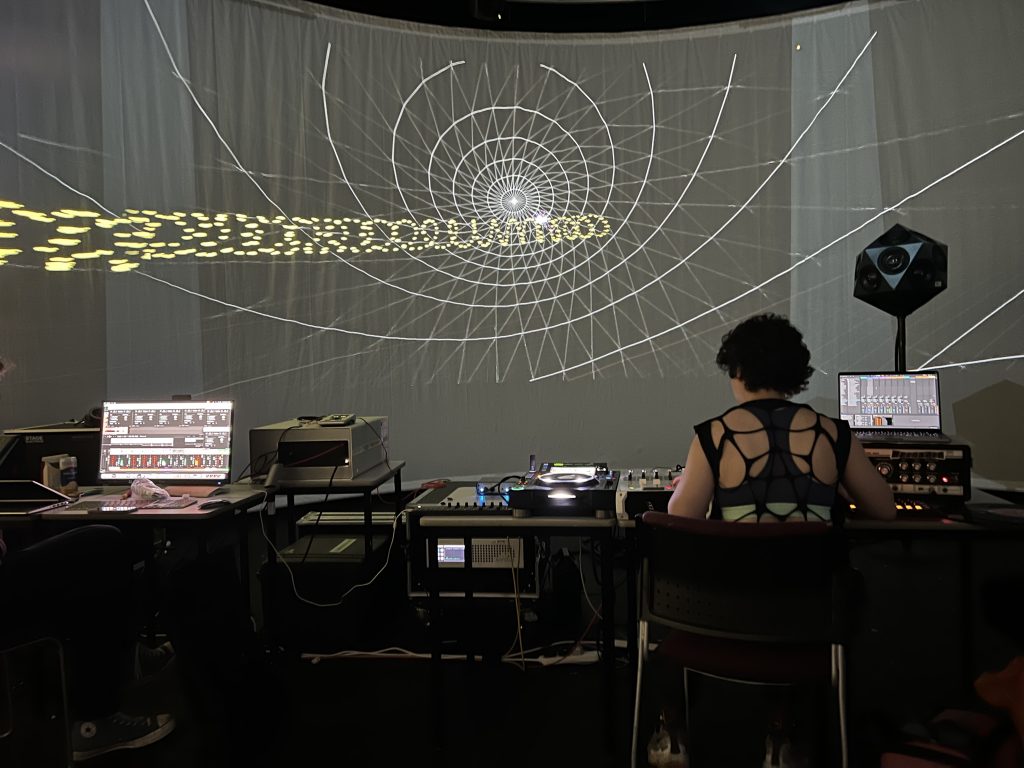
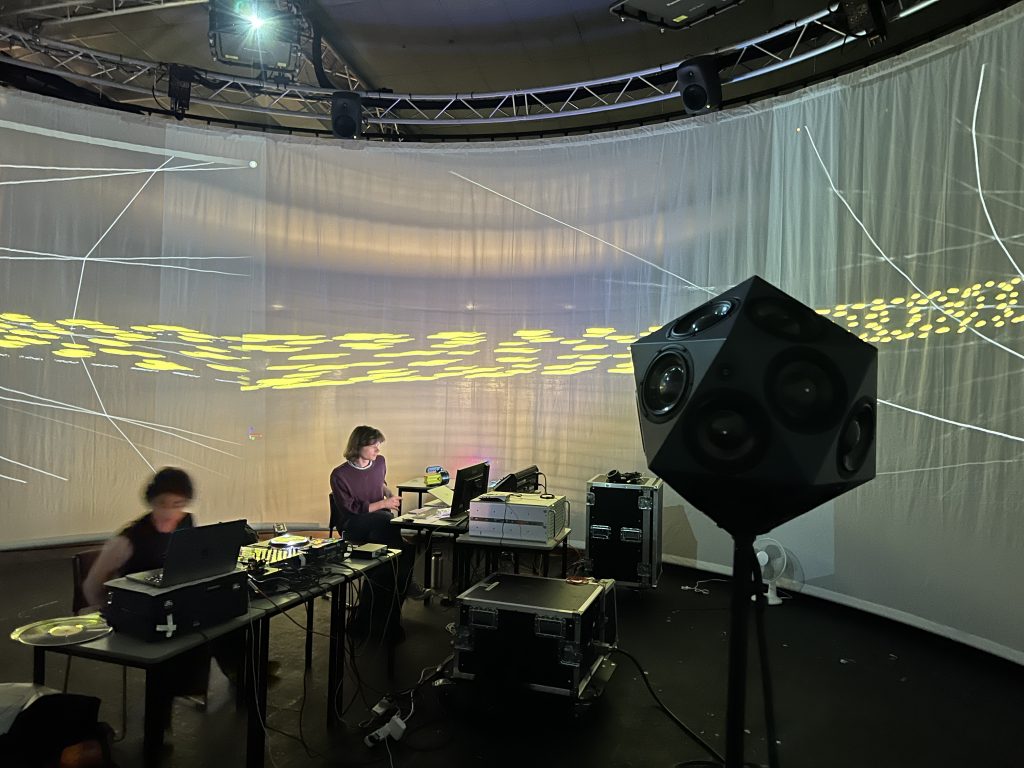
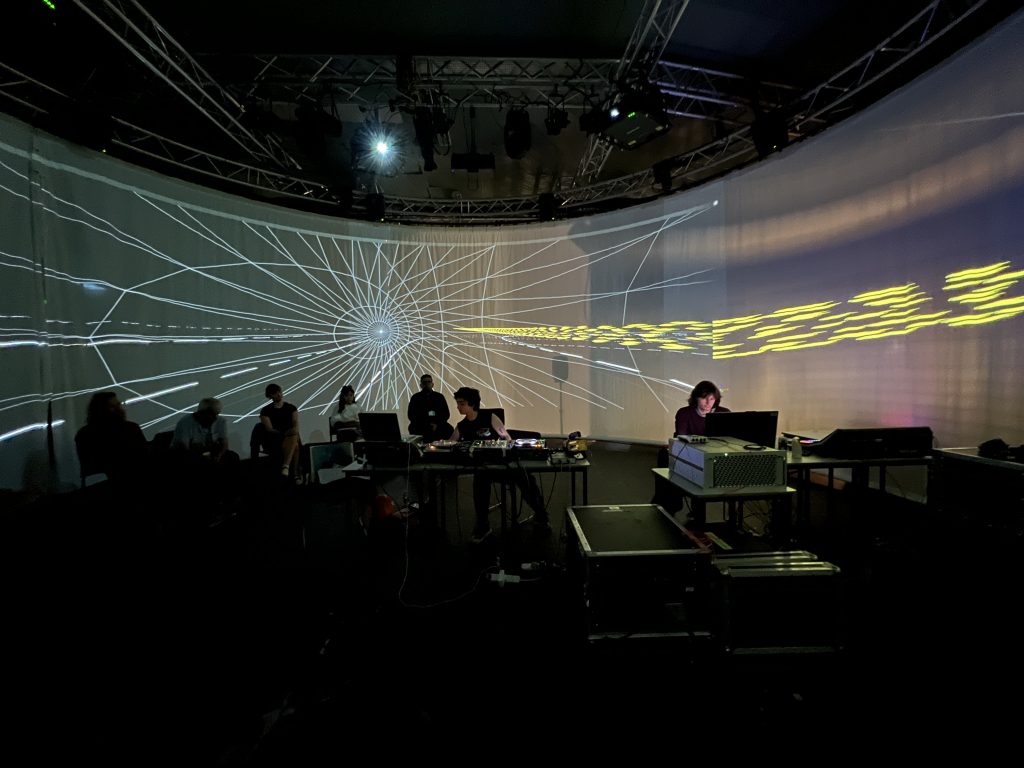

Shiva also worked with our IKO Loudspeaker, a compact 3D audio Loudspeaker. The portability of this loudspeaker means that artists can create works in response to the acoustics and materiality of a variety of different and unique spaces.
Below Shiva discusses her creative journey during her residency:
I spent 2 weeks in the Bathway Theatre working on my new interdisciplinary project LIQUID ZIGGURAT featuring a whole host of partners and collaborators including the Royal Welsh College of Music & Drama, SOUND/IMAGE Research Centre (Greenwich), Charranga, Third Ear (Ed McKeon), Sonic Arts Research Centre (Queen’s Belfast), Casa Del Lago (UNAM, Mexico City), Yoshi Sodeoka, Swaledale Festival and many more, funded by the Arts Council England’s National Lottery Project Grant.
On the first day I worked on the quality of my sound in response to the space and soundsystem, as well as getting a basic ambisonic system design running on Envelop 4 Live interfacing with the AIIRAD sound-system decoder. I wanted to sculpt my sound in response to the acoustics and design of the theatre and sound-system; it’s quite a unique system in the sense that the rectangular space has been divided into 3 sound system sections: a top space, a centre space, and a bottom space.
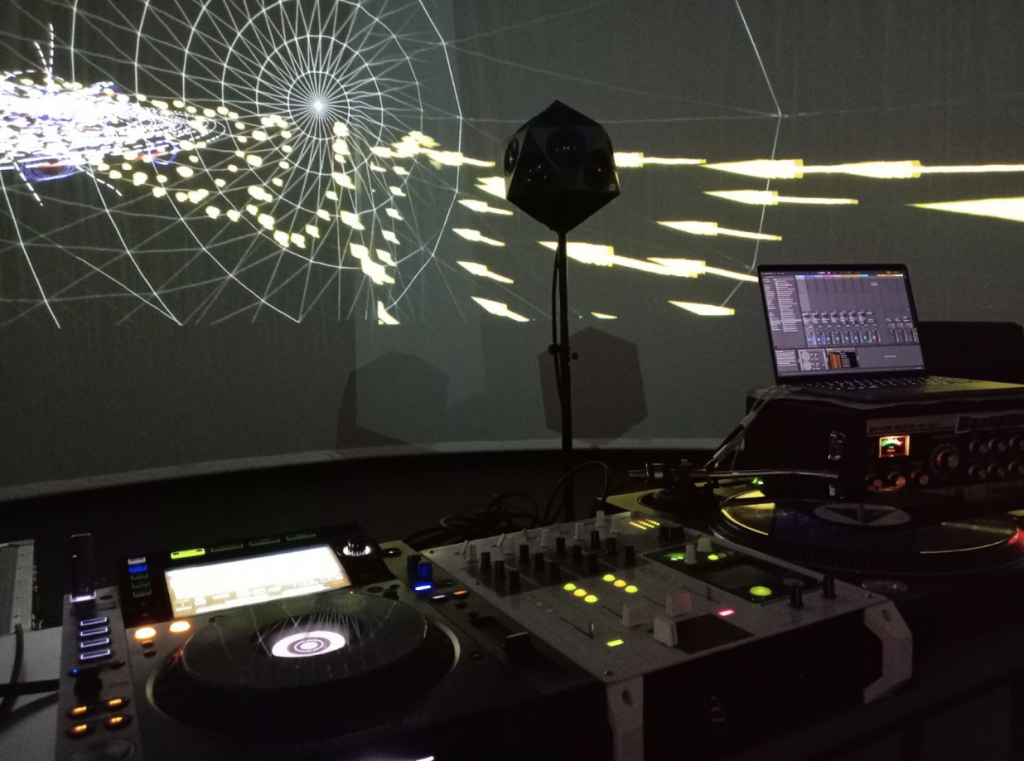
I wanted to find a way to utilise this design in creative ways so that wherever you stand in the space you had both a decent localized immersive sound, as well as being able to hear the full depth of the space within an overarching sculptural spatial sound design. And so, I spent the next several days experimenting with creative and repurposed usages of ambisonic systems. I conducted these tests by spending some dedicated time improvising and manipulating sound on my turntables, CDJ and analogue space echo, sending a variety sounds, timbres, and frequencies around the space and hearing what iterations worked well. After some playful exploration of different ambisonic configurations I decided to treat the top, centre and bottom spaces as three ambisonic spaces that mirrored each other, and a fourth space which treated the entire rectangular space as one overarching ambisonic space that provided a “glue”. Finally, I treated the subs as their own, fifth, stereo system to create a very stable bass sound to frame the space and spatial sound of the tops. This configuration as a whole had a very strong and rich immersive sound no matter where you stood in the space. I then extended this creatively and offset all the systems at “random” asymmetrical rotations, in order to achieve that depth of sculptural sound I was after. When the rotations are “clashing” you can start to distinctly hear what is happening in every section of the space and system, whilst still feeling that over-aching stable local immersive sound.
Now that I had a sound and a system I was happy with, I started to invite guests to listen and/or interact with the system including my colleague Simon Speare. We spent half a day improvising within the space, him on electric guitar, and myself using the live spatial turntablism I had developed. This helped me to define the more performative ideas of my project, through live performance improvisation.
I was then offered to work with the IKO which allowed me to further extend the acousmatic elements of my project, allowing the sound to travel outwards, reflecting sonically within the acoustic space, as well as interacting very well in contrast with the surround sound system that encased the space. I found that using the IKO with the subs was a great, contrasting combination of spatial sound and frequency, which is another creative repurpose of the technology.
Finally, I was able to start looking at the a/v interactions between the 3D sound and 3D video by Yoshi Sodeoka with design interactions by Nicholas O’ Brien. They had provided me with an initial blueprint of where the video could go in terms of spatial design (before any video content is actually added), and during the residency I was able to use an OSC interface to manipulate the spatial parameters of both the visuals and audio simultaneously, and choose which a/v interactions worked the best to feedback to Yoshi and Nicholas in New York. This was particularly useful on the theatre’s 360 degree cylindrical video screen.
An important part of the residency was inviting an accessibility advisory team of leading artists and accessibility experts to the residency to provide feedback on how to make the work accessible to a wide variety of people. These consultants were Nicola Woodham, Ysabelle Wombwell. Aja Ireland and Elizabeth Birch. I wanted this feedback to inform the artistic output of my work from the very beginning and not just be something that’s added at the end for purely practical reasons. Through these advisory sessions we discussed themes on how to listen in 3D, what to expect from the experience, and any accessibility considerations. The creative output of LIQUID ZIGGURAT will incorporate a neurodivergent and diverse perspective on sound and spatial perception, away from conventional binary approaches, sculpting both the experience and sound to multidimensional affect, to create a new form of spatial sound experience that hones in on a new, broader, and more malleable perspectives.
Words by Shiva Feshareki
See Shiva’s work with the IKO Speaker
Shiva Feshareki Biography:
A doctoral composition graduate from the Royal College of Music, Shiva Feshareki is an Ivor Novello award-winning British-Iranian composer and turntablist, at the intersection of contemporary-classical and electronic music. She has performed internationally in concert halls, art galleries and raves, with notable appearances at BBC Proms (Royal Albert Hall, London), Southbank Centre (London), Barbican Centre (London), De Bijloke (Ghent), Helmut List Halle (Graz), Sonar (Barcelona), Moscow Museum of Modern Art, Casa Del Lago (Mexico City) Mutek (Montreal), Berliner Festspiele (Kraftwerk, Berlin), Hellerau (European Centre for the Arts, Dresden), Kunstfestspiele Herrenhausen (Hannover), Amsterdam Dance Event, and Greek National Opera (Athens). Shiva has also performed her works alongside the BBC Singers, BBC Concert Orchestra, London Philharmonic Orchestra, London Contemporary Orchestra, Ensemble Modern, Nederlands Kamerkoor, RSO Wien, Düsseldorfer Symphoniker, Orchestre National de Lyon to name just a few.