Munazzah Iqbal
Higher education institutions have strong dedication to delivering quality learning experiences and therefore classrooms are often associated with structured lectures, teaching to detailed slides and careful explanation of theories (Forbes, 2021). Where lectures play an important role in introducing key concept and ideas, they do not always capture the complexity and dynamics that students will encounter beyond classrooms. It is therefore within the seminar settings that students get the opportunity to engage more actively with the taught concepts which promote what is often described as “deep learning”. Yet these seminars are often discussion-based and overly guided which limits the opportunity for students to fully think and apply the knowledge in practice (Rana, Dwivedi and Al-Khowaiter, 2017).
Why re-think seminars?
In my teaching, I began to notice a gap between understanding concepts in lectures and applying them in tutorials to cross-national contexts. While teaching concepts and facilitating discussion is often achievable, ensuring that students retain these ideas and apply them in meaningful, real-world contexts is a different challenge altogether.
At the same time, I observed that engagement increased significantly during sessions that required students to actively participate, collaborate, and solve problems together. This prompted me to rethink my approach: what if learning didn’t always feel like instruction and flip chart papers but instead felt like an experience where students could engage, experience, and reflect?
Experiential learning in practice
Play-based learning offers a way to explore this shift. This shift is grounded in experiential learning, where knowledge is created through experience and reflection rather than passive absorption. Within this framework, play-based activities are not simply interactive exercises, but are structured experiences that allow students to test ideas, make decisions, and learn from outcomes (Villarroel et al., 2020).
To bring this into my teaching, I introduced simple, structured activities into tutorials for a level 6 human resource management (HRM) module. These activities may appear playful on the surface, but they are designed to simulate real challenges and decision-making processes.
Applying experiential learning through play-based activities
Performance management and the Marshmallow Challenge
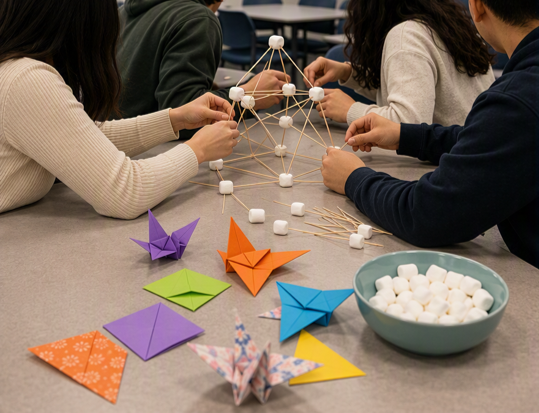
One of the activities used in tutorials is the Marshmallow Challenge. While it is commonly recognised as a team-building exercise, in this context it is deliberately structured to simulate the performance management process in action.
Students work in teams to build the tallest, most stable freestanding structure using limited materials within a defined time frame. However, rather than approaching it as an unstructured task, the activity is organised into distinct phases of planning, execution, review, and reflection, mirroring key stages of performance management.

At the outset, group members are required to set clear objectives, define success criteria (such as height, stability, and resource use), and assign roles. This planning phase reflects how organisations align individual and team goals with broader performance expectations. As the activity progresses, students engage in a midpoint review, where they pause to assess progress, exchange feedback, and adjust their strategies. This stage introduces the idea of continuous monitoring and feedback, which is central to effective performance management systems.
The second build phase allows groups to implement improvements based on their reflections, followed by a final evaluation where outcomes are assessed against predefined criteria. This structured sequence enables students to experience performance management not as a static appraisal exercise, but as an iterative and dynamic process.
The value of the activity lies in the debrief. Students reflect on how decisions were made, how feedback influenced outcomes, and how team dynamics affected performance. These reflections help them connect their experience to key concepts such as goal setting, performance monitoring, evaluation, and reward.
What becomes evident is that, although the activity begins as a collaborative and engaging task, it effectively provides an active experience of performance management processes. Students move beyond describing the process to understanding how it operates in practice, something that is often difficult to achieve through discussion alone.
Training and development and the Origami Butterfly Challenge
Another activity focuses on training and development through an Origami Butterfly Challenge. While the task itself appears simple, it is carefully designed to simulate how different training approaches influence learning, performance, and confidence.
The activity is structured in two stages. In the first stage, students are asked to create an origami butterfly without any instructions. This initial attempt introduces uncertainty and allows students to experience learning through trial and error. In the second stage, students are provided with structured training in different forms such as written instructions, video demonstrations, or guided support before attempting the task again.
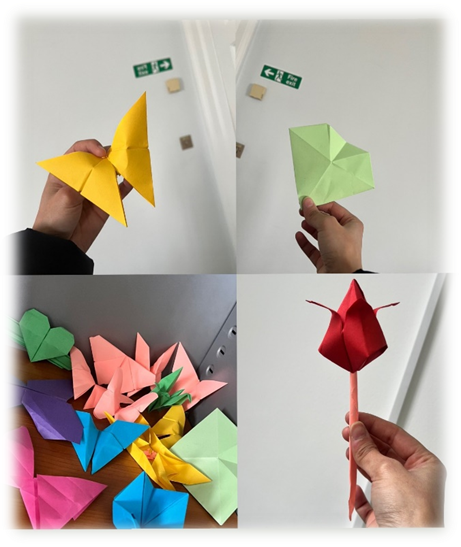
This contrast between unstructured and structured learning creates a powerful experiential insight. Students not only observe improvement in their performance but also become more aware of how training design affects efficiency, accuracy, and confidence.
The value of the activity lies in the reflection that follows. Students are encouraged to consider how they felt during each stage, how their performance changed, and which methods supported their learning most effectively. These reflections allow them to connect their experience to key training and development concepts, including instructional design, learning preferences, and the effectiveness of different training methods.
What becomes evident is that training is not simply about delivering information, but about designing learning experiences that are structured, contextual, and responsive to learners’ needs. By experiencing both the absence and presence of training, students gain a deeper understanding of its impact, something that is far more meaningful than discussing training methods in isolation.
Reflections on student learning
The introduction of these activities has led to noticeable changes in seminar dynamics. Students are more engaged, discussions are more grounded in experience, and participation has become more inclusive.
Importantly, students’ progress from descriptive accounts of concepts to demonstrating deeper understanding through play-based experience and reflection. They increasingly draw on their own experiences to interpret and evaluate theoretical ideas, rather than relying solely on abstract definitions.
This aligns with broader findings in play-based experiential learning, where engaging students in realistic scenarios enhances their ability to apply knowledge and think critically (Blinkoff et al., 2023).
Student feedback has been positive, with many highlighting that the activities helped translate abstract HRM concepts into practical learning experiences. Students reported greater engagement and participation during seminars and indicated that applying concepts through collaborative tasks supported their understanding of topics such as performance management, training and development, and teamwork, making the learning experience more memorable.
Final thoughts
This experience reinforces the value of experiential learning in higher education. While lectures provide essential theoretical foundations, seminars offer an opportunity to bring those theories to life.
Play-based activities, when designed with clear learning objectives and supported by reflection, can transform tutorials into spaces where students actively engage with knowledge, test their understanding, and learn from experience.
Ultimately, when learning begins to feel like play, it does not reduce academic rigour it enhances it by making learning more meaningful, memorable, and applicable.
References:
Blinkoff, E., Nesbitt, K.T., Golinkoff, R.M. and Hirsh-Pasek, K. (2023) ‘Investigating the contributions of active, playful learning to student interest and educational outcomes’, Acta Psychologica, 238. Available at: https://doi.org/10.1016/j.actpsy.2023.103983.
Forbes, L.K. (2021) ‘The Process of Play in Learning in Higher Education: A Phenomenological Study’, Journal of Teaching and Learning, 15(1), pp. 57–73. Available at: https://doi.org/10.22329/JTL.V15I1.6515.
Rana, N.P., Dwivedi, Y.K. and Al-Khowaiter, W.A.A. (2017) ‘Use of seminars for teaching and learning in higher education: Recommendations for business and management teaching’, International Journal of Business Excellence. Inderscience Publishers, pp. 238–255. Available at: https://doi.org/10.1504/IJBEX.2017.086341.
Villarroel, V., Benavente, M., Josefina Chuecas, M. and Bruna, D. (2020) ‘Experiential learning in higher education. A student-centered teaching method that improves perceived learning.’, Journal of University Teaching & Learning Practice, 17(5), p. 2020. Available at: https://ro.uow.edu.au/jutlpAvailableat:https://ro.uow.edu.au/jutlp/vol17/iss5/8.
Munazzah Iqbal is a Teaching Fellow in the Department of Business, Operations and Strategy at the University of Greenwich and a Fellow of the Higher Education Academy. She completed her PhD in Business and Social Sciences at Aston University and holds an MBA in Global Business from Coventry University. She is currently the Interim Programme Lead for BA Business Studies and module leader for International Human Resource Management.
Her research explores diversity, fairness perceptions, ethical leadership, and team dynamics, with a particular focus on how individuals make sense of differences and navigate fairness within diverse workplaces. Alongside her research, Munazzah is passionate about enhancing the student learning experience through innovative and inclusive pedagogies. She has a particular interest in experiential and play-based learning approaches that help students apply theoretical concepts in practical contexts. She is also involved in student-led co-creation projects, including Nudging Towards AI Integrity and Safe Learning Spaces, which aim to promote inclusive, engaging, and responsible learning environments.
Email: M.Iqbal@greenwich.ac.uk