Architecture and Landscape Open Day 23rd February 2013

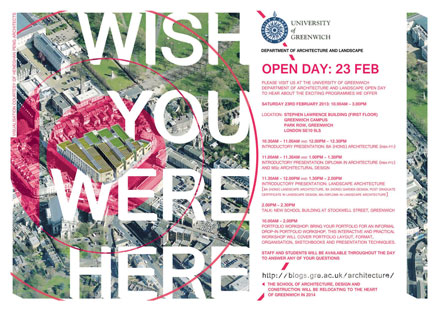
OPEN DAY: 23 February 2013

Please visit us at the University of Greenwich; Department of Architecture and Landscape Open Day to hear about the exciting programmes we offer

SATURDAY 23RD FEBRUARY 2013: 10.00AM – 3.00PM

Stephen Lawrence Building (First Floor)
Greenwich Campus
Park Row, Greenwich
London SE10 9LS

  • 10.30am – 11.00am and 12.00Pm – 12.30Pm
    Introductory presentation: BA (Hons) Architecture (RIBA Pt1)
  • 11.00am – 11.30Am and 1.00pm – 1.30pm
    Introductory presentation: Diploma in Architecture (RIBA Pt2) AND MSc ARCHITECTURAL DESIGN
  • 11.30Am – 12.00pm and 1.30pm – 2.00pm
    Introductory presentation: Landscape Architecture
    [BA (Hons) Landscape Architecture, BA (Hons) Garden Design, Post Graduate Certificate in Landscape Design, MA/Diploma in Landscape Architecture]
  • 2.00pm – 2.30pm
    TALK: New SCHOOL Building at Stockwell Street, Greenwich
  • 10.00am – 2.00pm
    Portfolio Workshop: Bring your portfolio for an informal drop-in portfolio workshop. This interactive and practical workshop will cover portfolio layout, format, organisation, sketchbooks and presentation techniques.

Staff and Students will be available throughout the day to answer any of your questions

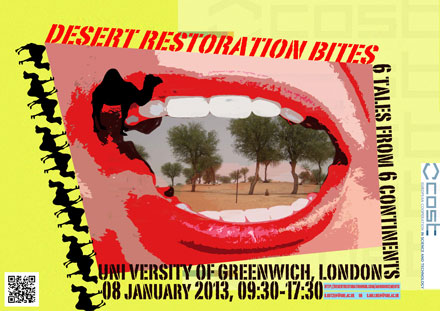
‘Desert Restoration Bites’ One Day Conference

The University of Greenwich and COST (European Cooperation in Science and Technology) will be hosting a one day conference on Arid Lands and Desert Restoration on the 8th of January 2013. Experts from around the world (USA, South Africa, China, Australia, Argentina, Spain) will speak on their experience and expertise with regard to restoration of degraded lands and sustainable land management.

The conference is free but must be reserved on the web at:

http://desertrestorationbites.eventbrite.co.uk

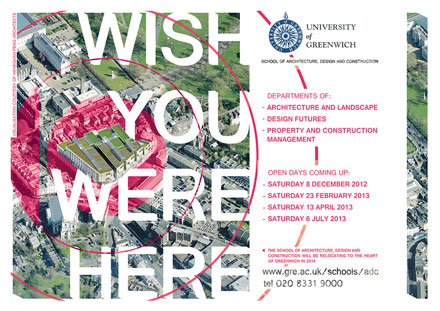
SoAD+C Open Days

The School of Architecture, Design and Construction has a number of open days coming up at the Avery Hill Campus:

  • Saturday 8th December 2012
  • Saturday 23rd February 2013
  • Saturday 13 April 2013
  • Saturday 6 July 2013

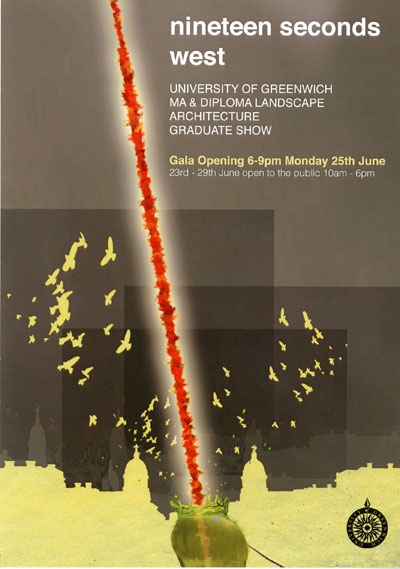
Landscape Architecture Summer Show

  • MA / Diploma in Landscape Architecture Graduate Show
  • Maritime Greenwich Campus
    Old Royal Naval College
    Park Row, London SE10 9LS
  • Saturday 23rd – Friday 29th June : 10AM – 6PM
  • Opening Party Monday 25th June : 6Pm

A video of the show opening by president of the Landscape Institute (and former Greenwich student) Joe Watkins is available to view here.

Summer Exhibitions 2012

These are the details of this year’s end of year shows.

Design Futures 2012 Graduate Show (Graphic and 3D Digital Design)

‘Free Range’, Truman Brewery, Brick Lane, London E1
www.free-range.org.uk

Private View Thursday 31st May 7pm

Open to the Public:

  • Thursday 31st May – Monday 4th June

Architecture 2012 Summer Exhibition

Queen Anne Court 1st Floor
Greenwich Campus
Old Royal Naval College
Park Row, London SE10 9LS

Opening Party – Friday 1st June 2012 6pm

Open to the public:

  • Saturday 2nd June and Sunday 3rd June
  • Saturday 9th and Sunday 10th June
  • Tuesday 12th and Wednesday 13th June
  • Saturday 16th and Sunday 17th June

Saturdays 10am to 6pm; Sundays 12noon to 5pm
Weekdays 10am to 8pm

Landscape Architecture and Garden Design 2012 Postgraduate Show

Queen Anne Court 1st Floor
Greenwich Campus
Old Royal Naval College
Park Row, London SE10 9LS

Private View – Monday 25th June 6pm

  • Saturday 23rd June – Thursday 28th June

Digitalstudio.gre.ac.uk/exhibition2012

Future Cities: Design as Research Conference – 19 / 20 April 2012

“Future Cities” Conference; A 2 Day Event in Maritime Greenwich

Speakers Include

  • Neil Spiller
  • Nic Clear
  • Rachel Armstrong
  • Pat Cadigan
  • Kibwe Tavares
  • Arne Hendricks
  • Carlos Olguin
  • Mark Morris
  • Simon Herron
  • John Hopkins

For the first time in human history we are witnessing the advent of megacities – seemingly endless urban expanses that house more than 10 million densely packed inhabitants seeking jobs in these economic hubs of activity, some of which even warrant their own buildings.

But these cities are not the product of ingenious design. Megacities spread like weeds across the landscape straining already stressed modern infrastructures to breaking point and causing potentially life threatening issues such as, crime,homelessness, waste & resource management, disease, traffic congestion and pollution.

By the middle of this century there will be another third again of people taking up residence in cities and we are facing a crisis caused by human design – or lack of it. The future of humanity depends on the prosperity of cities and many stakeholders are exploring new ways to create buildings, finding fresh approaches to managing information to help find order in chaos and encouraging biological systems to revitalize the health of our cities – as an attempt to change the pathway to catastrophe that we’ve already set in motion through global industrialization and relative urban prosperity.

This two day event explores some of the issues that our future cities are facing and proposes a way forwards through a new way of thinking about cities that we have called ‘Reflexive Urbanism’. This is a synthesis of technologies (both virtual and actual), contextual urban strategies and theories of urbanism that imbue the environment with lively infrastructures at all scales of the city. These urbanisms are highly dynamic, chemical and responsive.

‘Reflexive Urbanism’ is the prelude to NIBC convergence, which will be deployed to solve the biggest issue of this century – Megacities and their environmental impact on our climate. This approach embraces new technologies, dynamic infrastructures, ‘agile’ architectures and alternative forms of economics to harness the radical creativity possessed in urban environments. This change is brought about by over-prescribing top-down imperatives, systems of control or scientific/engineering abstractions.

‘Reflexive Urbanism’ works with the messiness of cities, their vibrant natures and their inherent subversion, to identify new solutions for the practice of the built environment in a resource constrained world.

Reflexive Urbanism proposes that cities of the future are not made but evolved. These cities do not operate like machines but behave according to surrealist agendas operating through a portfolio of advanced, combined technologies. The portfolio of new tools, which are hybrids of synthetic biology, augmented reality and complexity chemistry, sets the scene for a new group of materials and architectural interventions that blur the distinction between building and landscape and constitute synthetic urban ecologies. These ‘living technologies’ can evolve the city fabric in conjunction with its community operating at many scales ranging from the micro scale, to the city. Importantly these architectures result from the strategic applications of living technologies and are based on real world experiments. from their materials, infrastructures and communities.

Uniquely this event brings together a diverse range of stakeholders from academia and business that will be invited to engage with some of the biggest challenges that we face today. The first day is dedicated to a public forum and conference with speaker presentations and a moderated roundtable discussion examining many important urban and architectural issues.

The second day is one of facilitated conversations and identification of next steps towards establishing a future cities platform based in academia, which works alongside industry to research, experiment and propose alternative approaches to the rejuvenation and sustainability of our cities vital for an integrated, visionary approach in addressing this global Grand Challenge.
For further information please visit

www.gre.ac.uk/schools/arc/rss-assets/news/future-cities
Garden Design Students’ Ideas on display at Knole

University of Greenwich students are putting on an exhibition of design, conservation and management ideas for the park and garden of Knole in Sevenoaks, Kent. The historic Grade I listed house has been owned by the National Trust since 1946. Its 1000-acre great medieval deer park is 90 per cent owned and managed by the Sackville-West family, and 10 per cent by the National Trust.

Lord Sackville says: “When I was first approached by the Garden Design students at the University of Greenwich, I had no idea what to expect. But I’m sure that you’ll be as impressed and inspired by their work as I was. They have come up with some beautiful ideas that respect the history and spirit of Knole, while at the same time adding a contemporary twist.”

The possible ideas come from 17 final year BA (Hons) Garden Design degree course students and one studying MA in Garden History that undertook the work as a historic garden conservation project on behalf of the Sackville-West family, who live in the house. The ideas are a mixture of modern designs and the restoration of some historic ones from previous centuries.

The exhibition will feature the student’s conservation plans, plus scale models of their work. They have looked at planting and management within the garden and park, and at some areas owned by the National Trust and open to visitors, such as the Brewhouse Tearoom courtyard, Green Court, and the car park.

Marian Boswall, Lecturer in historic garden conservation at Greenwich, says: “These are theoretical ideas for Lord Sackville and the National Trust to enjoy or employ as they wish. The student’s drawings and models show individual conservation, management and design ideas. Group projects explain and illustrate the history, geography and social life of the park and garden.”

Designs for the Park and Garden at Knole, a free exhibition which begins in March, will take place in the 200-year-old Orangery, which was opened to the public in 2010. It is on the south side of the house, looking on to Lord Sackville’s private garden.

Exhibition opening times:

  • Saturday 3 and Sunday 4 March, 11am – 4pm
  • Wednesday 10 March to Sunday 1 April, 10.30am – 5pm (closed Monday and Tuesday)
  • Tuesday 3 April – Sunday 15 April, 10.30 am – 5pm (closed Monday except 9 April).

Please note that Lord Sackville’s private garden opens to the public, Tuesdays only, from April 3, 11am – 4pm.

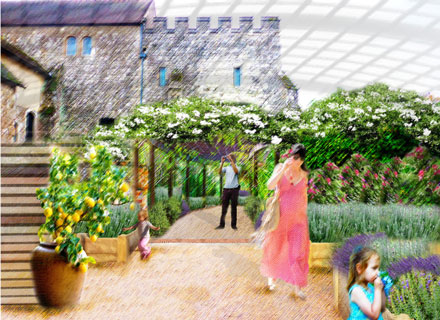
[Picture: A design by Harriet Farlam, 3rd year BA garden design student, to turn the current cafe yard into a covered dining area with a transparent dome. ]

Find out more about Knole:

www.nationaltrust.org.uk/knole/

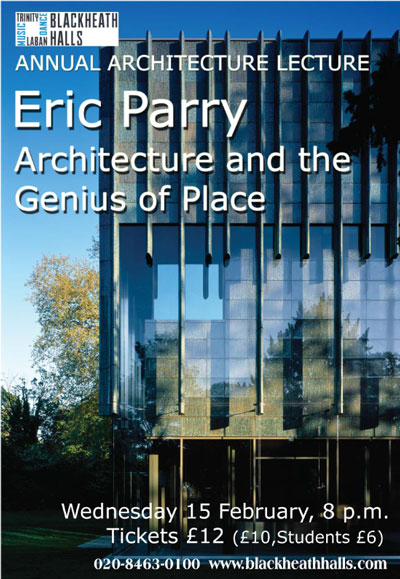
ANNUAL ARCHITECTURE LECTURE by ERIC PARRY: Architecture and the Genius of Place:

  • ANNUAL ARCHITECTURE LECTURE by ERIC PARRY:
    Architecture and the Genius of Place:
  • WEDNESDAY 15 FEBRUARY 8pm
  • Blackheath Halls, 23 Lee Road, SE 3 9RB.
  • TICKETS: £12 Concessions £10 Students £6, Box Office 020 8318 9758, e-mail: blackheathhalls@trinitylaban.ac.uk

Well-known for his renewal of St Martin in the Fields, Eric Parry has a reputation for beautifully crafted buildings that respond to their context with exceptional flair.  He will be talking about how a contemporary designer can mediate between the voices of the past and the future, illustrating amongst other projects the recently completed extension to the Holburne Museum in Bath.