The Hawksmoor International Lecture Series 2015-16 :: James Corner :: Intimate Immensity: Public Space in the City

  • Thursday 19th November 2015, 6.30pm
  • Tessa Blackstone Lecture Theatre [11_0003]
151119_JamesCorner_flyer

This lecture is now available to view online

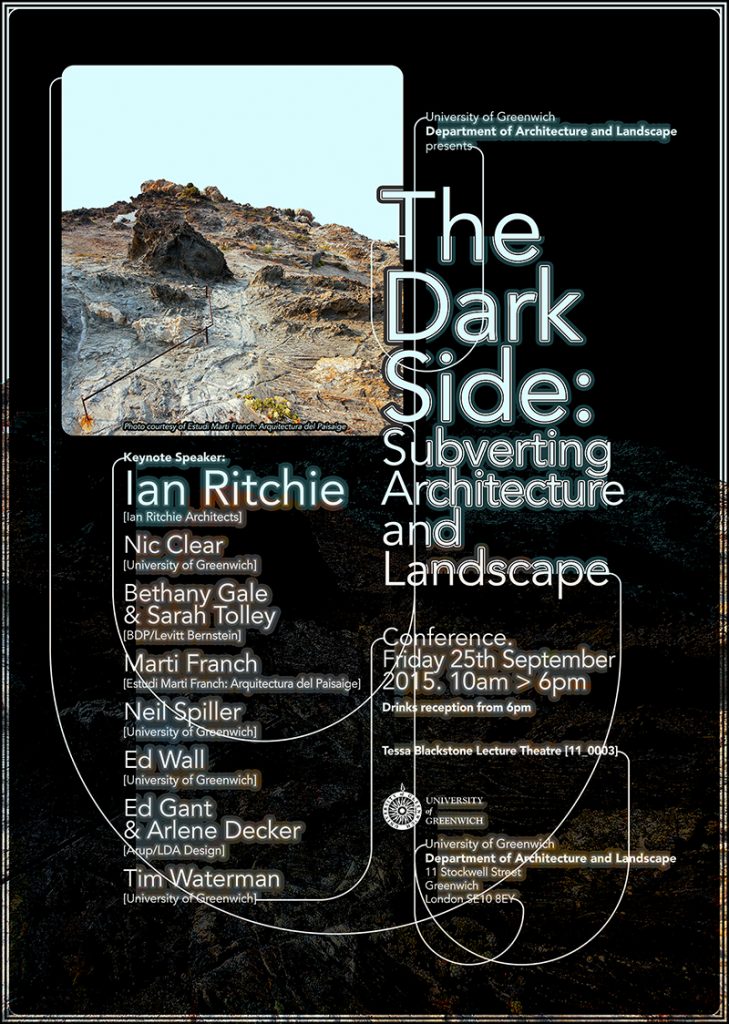
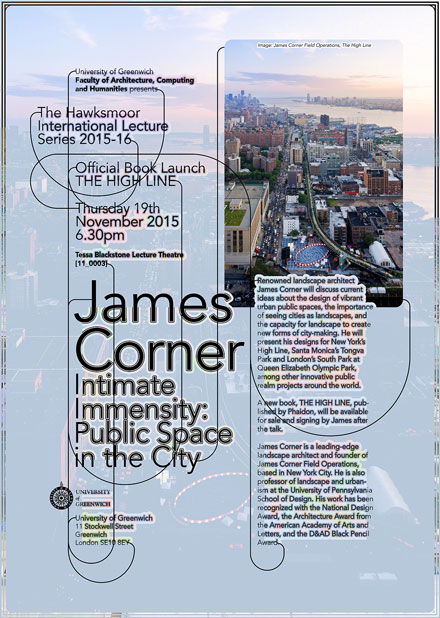
Renowned landscape architect James Corner will discuss current ideas about the design of vibrant urban public spaces, the importance of seeing cities as landscapes, and the capacity for landscape to create new forms of city-making. He will present his designs for New York’s High Line, Santa Monica’s Tongva Park and London’s South Park at Queen Elizabeth Olympic Park, among other innovative public realm projects around the world.

A new book, THE HIGH LINE, published by Phaidon, will be available for sale and signing by James after the talk.

James Corner is a leading-edge landscape architect and founder of James Corner Field Operations, based in New York City. He is also professor of landscape and urbanism at the University of Pennsylvania School of Design. His work has been recognized with the National Design Award, the Architecture Award from the American Academy of Arts and Letters, and the D&AD Black Pencil Award.
The Hawksmoor International Lecture Series 2015-16 :: Gavin Parkinson :: Seurat’s Surrealist Dialectic

  • Thursday 12th November 2015, 6.30pm
  • Tessa Blackstone Lecture Theatre [11_0003]

151112_GavinParkinson_flyer

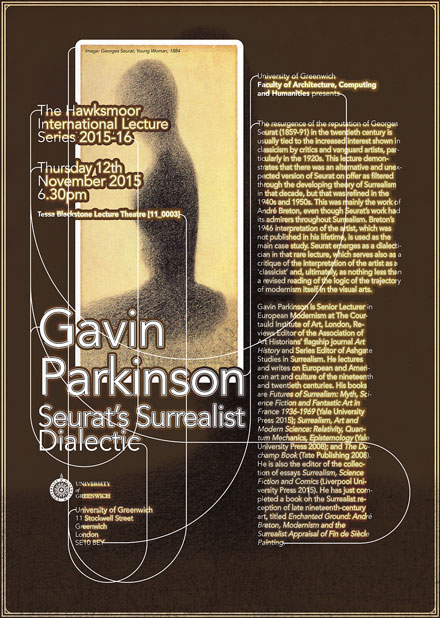
The resurgence of the reputation of Georges Seurat (1859-91) in the twentieth century is usually tied to the increased interest shown in classicism by critics and vanguard artists, particularly in the 1920s. This lecture demonstrates that there was an alternative and unexpected version of Seurat on offer as filtered through the developing theory of Surrealism in that decade, but that was refined in the 1940s and 1950s. This was mainly the work of André Breton, even though Seurat’s work had its admirers throughout Surrealism. Breton’s 1946 interpretation of the artist, which was not published in his lifetime, is used as the main case study. Seurat emerges as a dialectician in that rare lecture, which serves also as a critique of the interpretation of the artist as a ‘classicist’ and, ultimately, as nothing less than a revised reading of the logic of the trajectory of modernism itself in the visual arts.

Gavin Parkinson is Senior Lecturer in European Modernism at The Courtauld Institute of Art, London, Reviews Editor of the Association of Art Historians’ flagship journal Art History and Series Editor of Ashgate Studies in Surrealism. He lectures and writes on European and American art and culture of the nineteenth and twentieth centuries. His books are Futures of Surrealism: Myth, Science Fiction and Fantastic Art in France 1936-1969 (Yale University Press 2015); Surrealism, Art and Modern Science: Relativity, Quantum Mechanics, Epistemology (Yale University Press 2008); and The Duchamp Book (Tate Publishing 2008). He is also the editor of the collection of essays Surrealism, Science Fiction and Comics (Liverpool University Press 2015). He has just completed a book on the Surrealist reception of late nineteenth-century art, titled Enchanted Ground: André Breton, Modernism and the Surrealist Appraisal of Fin de Siècle Painting.


The Hawksmoor International Lecture Series 2015-16 :: Hanif Kara :: Designed Engineering

  • Thursday 5th November 2015, 6.30pm
  • Tessa Blackstone Lecture Theatre [11_0003]

151105_HanifKara_flyer

Technology has obviously changed both architecture and engineering, and the potential for interaction. It has also redefined what each discipline calls ‘Design’. Today, as we enter the post digital era, the role of the structural engineer in ‘Design’ and the processes he uses to realise this varies. Through a selected set of projects this presentation will address ‘practice’, ‘education’ and ‘deliverance’ of design borne out of ‘technical excellence and aesthetic curiosity’ from a small corner of London that is the home of AKT II.

Hanif Kara combines Structural Engineering Practice with teaching, and is currently appointed as Professor in Practice of Architectural Technology at the Graduate School of Design, Harvard. He is a fellow of RAE, RIBA, ICE, IStructE, RSA, on the board of trustees of the Architecture Foundation, formerly a CABE Commissioner and served as a member of the Design for London Advisory Group to the Mayor of London. As Design Director and co-founder of AKT II his particular ‘design-led’ approach and interest in innovative form, material uses, and complex analysis methods have allowed him to work on numerous award-winning, pioneering projects. He is widely published with works including ‘Design Engineering’, a retrospective of AKT’s first decade, 2008; co-published with Harvard ‘Interdisciplinary Design: New Lessons from Architecture and Engineering’, 2012; and most recently he edited ‘Deliverance of Design – Making, Mending and Revitalising Structures’ – a look at the works of AKT II from 1996 – 2016. Selected projects include the Energy Centre – Olympic Park London, Birmingham New Street Station 2015, Peckham Library London, Bloomberg Headquarters London, Central Park Bridge Olympics London, The Francis Crick Institute London, and The National Trust Headquarters Swindon.


www.akt-uk.com


The Hawksmoor International Lecture Series 2015-16 :: Nic Clear :: to be confirmed…

  • Thursday 29th October 2015, 6.30pm
  • Tessa Blackstone Lecture Theatre [11_0003]

151029_NicClear_poster

It seems easier for us today to imagine the thoroughgoing deterioration of the earth and of nature than the breakdown of late capitalism.

– Frederic Jameson

The dominance of neoliberalism makes the possibility of alternative ways of organising society seem remote, however it needs to be remembered that – far from being historically enshrined inevitabilities – they are comparatively recent ideological inventions. The myths of the infallibility and inevitability of late capitalism are its greatest conceit. With reference to a wide variety of sources, this lecture will map out the cultural context of late capitalism and identify tactics and strategies of resistance, playfully suggesting that the future is far from certain, and that this is probably for the better.

Nic Clear is the Head of Department of Architecture and Landscape at the University of Greenwich where he teaches Unit 15, a postgraduate architecture unit that uses film and animation to generate, develop and represent architectural projects.

The Hawksmoor International Lecture Series 2015-16 :: Neil Spiller :: Surreal Bodies

  • Thursday 22nd October 2015, 6.30pm
  • Tessa Blackstone Lecture Theatre [11_0003]

151022_NeilSpiller_flyer

Above all, the Surrealist legacy is about bodies: their mutability, desire, viscera and, due to advancements in technology, their increasing transparency – all of which are also fundamental to the ongoing discourse concerning architectural space. The Surrealist body is an open concept, forever in metamorphosis. It has assimilated machines, flora and fauna, animals, alien geometries and fetishistic hungers. Simultaneously bloody and dry, deviant and pure, void and mass, the body, with its infinite potential for the uncanny coupled with humankind’s ability to hold up a disturbing mirror to ourselves, is the oil that lubricates Surrealism’s machinery – its prima materia.

Neil Spiller is Hawksmoor Chair of Architecture and Landscape and Deputy Pro Vice-Chancellor of the University of Greenwich, London. Prior to this he was Dean of the School of Architecture, Design and Construction and Professor of Architecture and Digital Theory at Greenwich University. Before this he was Vice-Dean and Graduate Director of Design at the Bartlett School of Architecture, University College London. Neil’s numerous books include Cyberreader: Critical Writings of the Digital Era (2002) and Visionary Architecture – Blueprints of the Modern Imagination (2006). Since 1998, he has been producing the epic COMMUNICATING VESSELS project. Neil is also known as the founding director of the AVATAR (Advanced Virtual and Technological Architectural Research) Group, now based at the University of Greenwich.

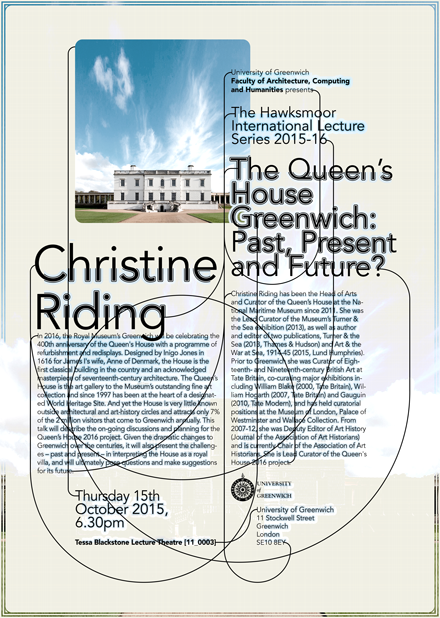
The Hawksmoor International Lecture Series 2015-16 :: Christine Riding :: The Queen’s House, Greenwich: Past, Present and Future?

  • Thursday 15th October 2015, 6.30pm
  • Tessa Blackstone Lecture Theatre [11_0003]

151015_ChristineRiding_poster

In 2016, the Royal Museum’s Greenwich will be celebrating the 400th anniversary of the Queen’s House with a programme of refurbishment and redisplays. Designed by Inigo Jones in 1616 for James I’s wife, Anne of Denmark, the House is the first classical building in the country and an acknowledged masterpiece of seventeenth-century architecture. The Queen’s House is the art gallery to the Museum’s outstanding fine art collection and since 1997 has been at the heart of a designated World Heritage Site. And yet the House is very little known outside architectural and art-history circles and attracts only 7% of the 2 million visitors that come to Greenwich annually. This talk will describe the on-going discussions and planning for the Queen’s House 2016 project. Given the dramatic changes to Greenwich over the centuries, it will also present the challenges – past and present – in interpreting the House as a royal villa, and will ultimately pose questions and make suggestions for its future.

Christine Riding has been the Head of Arts and Curator of the Queen’s House at the National Maritime Museum since 2011. She was the Lead Curator of the Museum’s Turner & the Sea exhibition (2013), as well as author and editor of two publications, Turner & the Sea (2013, Thames & Hudson) and Art & the War at Sea, 1914-45 (2015, Lund Humphries). Prior to Greenwich she was Curator of Eighteenth- and Nineteenth-century British Art at Tate Britain, co-curating major exhibitions including William Blake (2000, Tate Britain), William Hogarth (2007, Tate Britain) and Gauguin (2010, Tate Modern), and has held curatorial positions at the Museum of London, Palace of Westminster and Wallace Collection. From 2007-2012, she was Deputy Editor of Art History (Journal of the Association of Art Historians) and is the current Chair of the Association of Art Historians. She is the Lead Curator of the Queen’s House 2016 project.

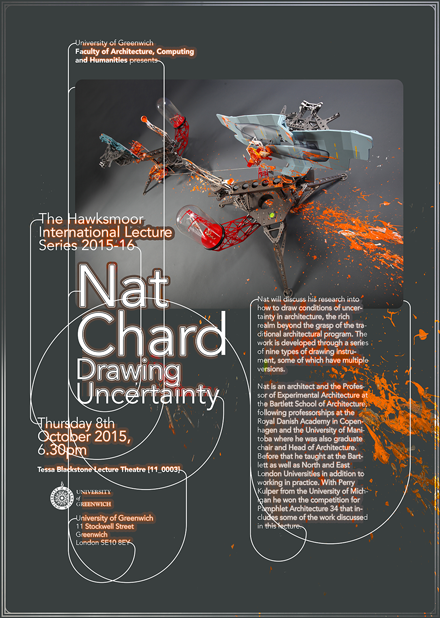
The Hawksmoor International Lecture Series 2015-16 :: Nat Chard :: Drawing Uncertainty

The Hawksmoor International Lecture Series 2015-16

Nat Chard  ::  Drawing uncertainty

  • Thursday 8th October 2015, 6.30pm
  • Tessa Blackstone Lecture Theatre [11_0003]

151008_NatChard_flyer

Nat will discuss his research into how to draw conditions of uncertainty in architecture, the rich realm beyond the grasp of the traditional architectural program. The work is developed through a series of nine types of drawing instrument, some of which have multiple versions.

Nat is an architect and the Professor of Experimental Architecture at the Bartlett School of Architecture, following professorships at the Royal Danish Academy in Copenhagen and the University of Manitoba where he was also graduate chair and Head of Architecture. Before that he taught at the Bartlett as well as North and East London Universities in addition to working in practice. With Perry Kulper from the University of Michigan he won’t the competition for Pamphlet Architecture 34 that includes some of the work discussed in this lecture.

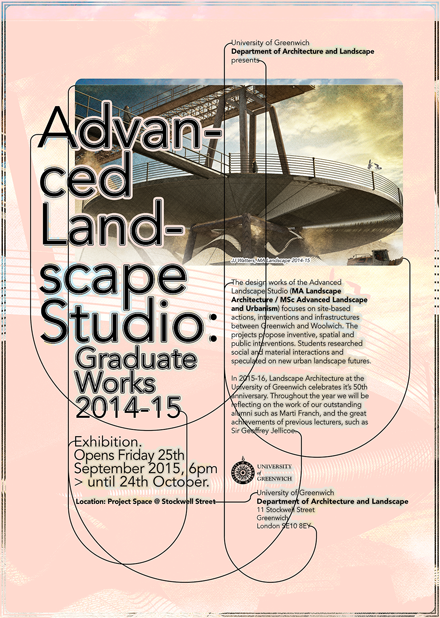
ADVANCED LANDSCAPE STUDIO: Graduate Works 2014-15

  • Exhibition. Opens Friday 25th September 2015, 6pm.
  • Project Space @ Stockwell Street

150925_Landscape-exhibition_flyer

The design works of the Advanced Landscape Studio (MA Landscape Architecture/MSc Advanced Landscape and Urbanism) is focused on site-based actions, interventions and infrastructures between Greenwich and Woolwich. Projects investigated the infrastructures of this South-East London landscape to speculate on inventive, spatial and public interventions. Students researched the social and material interactions that have constituted sites and speculated on new urban landscape futures. In particular, projects enquire how small creative actions can inform, disrupt and find presence within large infrastructures.

In 2015/16 the Landscape Architecture programmes at the University of Greenwich celebrate their 50th anniversary. Throughout the year we will be reflecting on the work of our outstanding alumni such as Marti Franch, and the great achievements of previous lecturers, such as Sir Geoffrey Jellicoe

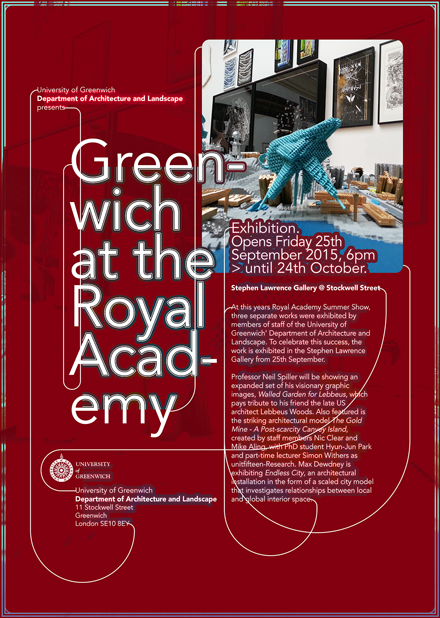
Greenwich at the Royal Academy

  • Exhibition. Opens Friday 25th September 2015, 6pm.
  • Stephen Lawrence Gallery @ Stockwell Street

150925_Greenwich-at-RA_flyer

At this years Royal Academy Summer Show, three separate works were exhibited by members of staff of the University of Greenwich’ Department of Architecture and Landscape. To celebrate this success an exhibition of the work is exhibited in the Stephen Lawrence Gallery from 25th September.

Professor Neil Spiller will be showing an expanded set of his visionary graphic images, The Walled Garden for Lebbeus, which pays tribute to his friend the late US architect Lebbeus Woods. Also featured is the striking architectural model ‘The Gold Mine – A Post-scarcity Canvey Island’ by staff members Nic Clear and Mike Aling, with PhD student Hyun-Jun Park and part-time lecturer Simon Withers as unitfifteen-research. Max Dewdney is exhibiting Endless City, an architectural installation in the form of a scaled city model that investigates the relationship between local and global interior space, both real and imagined, now and for the future.

The Dark Side :: Subverting Architecture and Landscape :: A University of Greenwich Conference

  • Friday 25 September
  • 10:00 – 18:00, reception
  • University of Greenwich, 10 Stockwell Street, Tessa Blackstone Lecture Theatre [11_0003]

150925_Dark Side conference_flyer


The Dark Side: Subverting Architecture and Landscape

‘It is hard to avoid the conclusion that the paramount axis of cultural conflict in Los Angeles has always been about the construction/interpretation of the city myth, which enters the material landscape as a design for speculation and domination.’

City of Quartz, Mike Davis, 1990:23


Architecture and landscape are easily subverted. Owen Hatherley (2015) suggests that the work of architects in London facilitates social cleansing, simultaneously the design of new landscapes is strategically formed to enhance property values and accelerate gentrification. The dark side of landscape, as critiqued by John Barrell (1980), points to concealed agendas which inform the representation of the landscape, in turn reinforcing the ideology. Barrell’s dark side exposes imperial ideologies, through the 18th century painting of pastoral scenes, which are claimed to still co-opt a scenographic design practice today (Corner 1999). Simultaneously, there are opportunities for alternate subversions, from ecological inventions to ludic ambitions, which could reimagine forms of practice.

The continual subversion/revolution of our disciplines is the subject of the 2015/16 conference at the University of Greenwich’s Department of Architecture and Landscape.