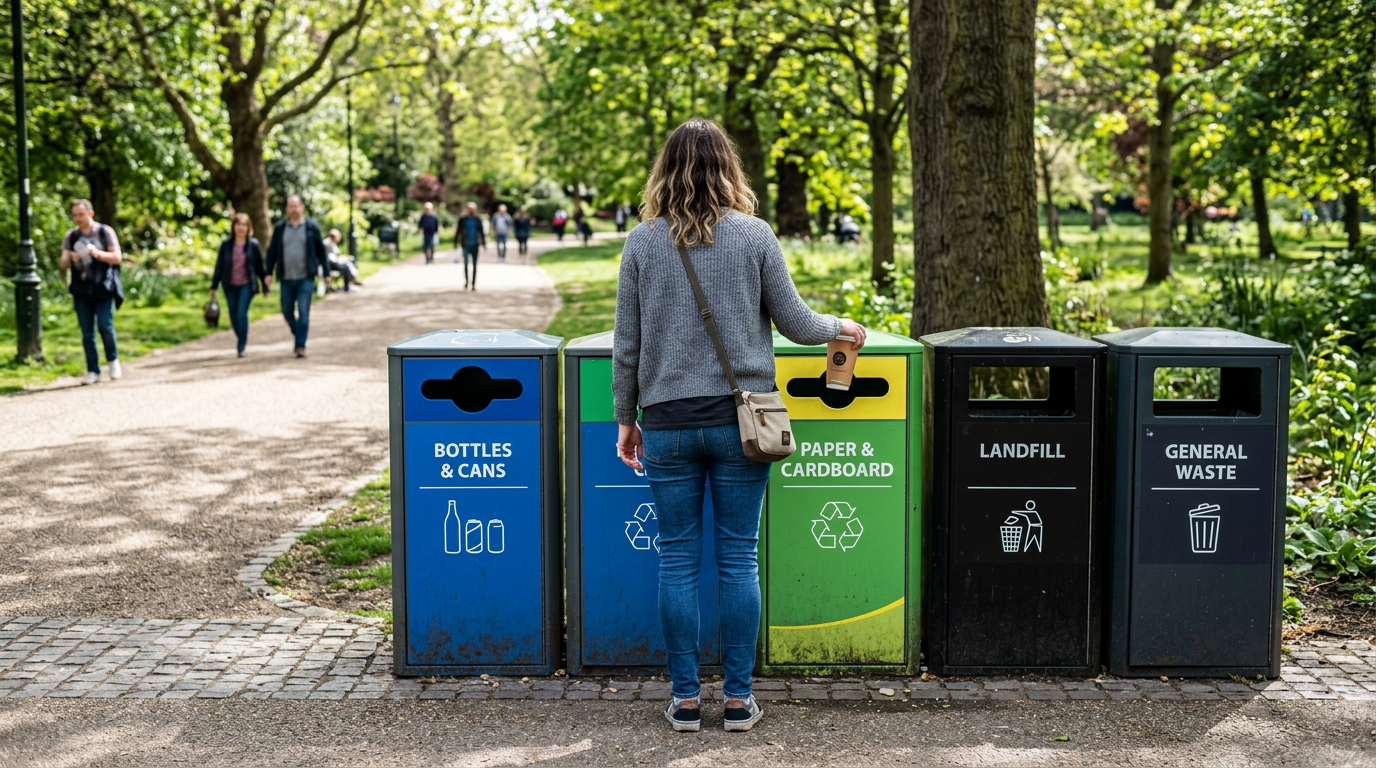
Did you know that an estimated 3.75-5 billion disposable coffee cups are used in the UK each year with less than 1 in 400 recycled?
Print a city’s name on a paper cup, and something interesting happens: people who feel connected to that city stop seeing it as trash. The label makes the cup feel like a small piece of home, and people don’t throw away pieces of home, they recycle them. The part that really surprised us: this effect gets even stronger when the city looks dirty or run down. People who love a place don’t walk away from it when it’s struggling, they want to help it, and recycling becomes their way of doing that.
Today, we talk to our beloved NUSC expert, Dr Jingxi Huang. Avid readers of the blog might recognise her name and face from previous features such as her research on when and why people might reject green rewards, her Meet the Member feature, or our Sneak Peak into her fantastic research on creative entrepreneurship in the elderly.
Dr Huang joins us today to talk about one of her latest papers, ‘Place label nudges: How place attachment shapes recycling choice‘, published in the Journal of Environmental Psychology, this paper was authored by colleagues from Lancaster University, Ahmad Daryanto and from Bejing Foreign Studies University, Zening Song.

As you may recall from Dr Huang’s Meet the Member feature, this interest in sustainable consumer behaviour, and how small nudges can effect big changes is not new. The project began before Dr Huang joined the University of Greenwich, right after her PhD Viva. Looking for opportunity in the mundane, Dr Huang and her supervisor recognised the potential of every day objects to signal emotions and behaviours. As Dr Huang explains, “from the beginning, our goal was to create something that people, even outside of academia, could understand easily and use in real life.”
In a nutshell, Dr Huang and colleagues found that, “If you feel attached to a place, you’re more likely to do things that help it, even recycling a paper cup, because a cup labelled with that place starts to feel like part of who you are.” Fascinating right? Dr Huang and colleagues made use of not one, but seven, experiments to provide evidence for this phenomena, as she explains:
My favourite part was watching a small idea grow step by step into a full and quite detailed research design. For example, in Study 1, we simply gave people a choice between a place-labelled cup and a plain one, and people who felt more attached to that place chose the labelled cup to recycle. After that, we kept building on it: we tested the same idea in different ways, removed other possible explanations, and later added a city-cleanliness condition to see how that changed the result. What I liked most was seeing how each new study connected to the one before it, and how together they made our argument stronger and more solid. It shows that a small idea can grow into something much bigger than you expect.
All seven studies, the five main ones and the two in the appendix, used paper cups. This was on purpose: it let us keep things controlled and easy to compare across studies, instead of changing too many things at once. Even so, we tested the idea in many different ways, some studies used a choice between two cups, one used a between-subject design, we tested different city pairs, different groups of residents, and we also ruled out other possible explanations such as product liking, residency, and social norms. So the evidence for the main idea is quite strong. What we have not done yet is change the type of product. That is the next step. Since the idea is really about identity, not about the object itself, we believe it should also work for other single-use items, like takeaway boxes or water bottles. That is something I would like to test next.
As Dr Huang explains, most previous research on recycling looks at ‘rewards or rules, like fees or fines’ such approaches are quite laborious to maintain. Instead, Dr Huang presents a simple, low-cost, way to encourage recycling. Her work not only shows it works, but through the series of experiments, can convincingly demonstrate why it works: “people already knew that place attachment is connected to pro-environmental behaviour, but nobody had really explained why, in terms of buying and using products. We show it is because the place label creates a personal connection to the product itself, and that connection is what leads to the recycling choice.”. Not only this, but Dr Huang and colleagues have uncovered a new psychological process:
This is the part I find most interesting, earlier work (Trudel et al., 2016) found that when a product is connected to your identity in a negative way, you want to get rid of it, to create distance. We find almost the opposite when the negative thing is about the place, not the product: people who are attached want to protect the place, not move away from it. So a “dirty city” image makes them more likely to recycle, not less, which is a different psychological process than what was described before.
Naturally, I had a few questions about the research, like how is labelling cups with a place name different from a branded coffee cup, particular as it could mention the location. Dr Huang explained, and did so in a way that makes it clear how organisations can leverage this phenomena:
It works in a different way. A branded cup works because of what people think about the company itself, for example Starbucks versus Costa versus Caffè Nero, each one has its own image. A place label does not use the brand at all. Instead, it uses something the consumer already has: their own attachment to a city, like Beijing, Shanghai, or London. It works the same way no matter which brand’s cup it is printed on, because it is about identity, not about the company. Coca-Cola did something similar a few years ago with city-themed bottles, putting city names on packaging without it being about the product itself. Because it does not depend on the brand’s image, any business can use this idea cheaply, no matter what they sell.
I adore the town that I current live in, and I would do anything to keep it at its best (anything may be a bit of an overstatement, but I certainly wouldn’t litter). In contrast, I detest the town I grew up in. So naturally, I wondered, if this phenomena depends on attachment to the place- what if you are not attached to the place? What if, you actually kind of hate it?
That is a good question. We did not directly measure “hating” a place, but we did compare people living in different cities. For example, Beijing residents choosing between a Shanghai-labelled cup and a Beijing-labelled cup usually chose the Beijing one, because their attachment was stronger there. We also found that when a city was shown as dirty or messy, this made the link between attachment and recycling even stronger, not weaker. So this research is really about attachment, not about disliking a place. If someone truly has no attachment to a place, this kind of nudge probably will not have much effect on them. But most people, even with mixed feelings about somewhere, still feel some attachment to where they are from or where they have lived, and that is the group this kind of idea could really work for.
Dr Huang and colleagues conducted this research on Chinese consumers, and as Dr Huang explains, “wherever you’re from, there’s probably some place that feels like home to you, and that feeling doesn’t need translating” – nonetheless, she would like to explore more deeply how this might work for tourists and visitors rather than residents.
Another direction I find really interesting is about the different types, or levels, of place people feel attached to. Think about it this way: I could feel attached to the UK as a country, to London as a city, to the University of Greenwich as our workplace, or simply to the street where we live. Most people actually feel attached to several of these at the same time, not just one. So a good question for future research is: which level of place attachment pushes people the most toward recycling? Is it the big, national-level identity, the city you call home, or something smaller and more personal, like your neighbourhood or your workplace? I would love to test products labelled at these different levels side by side, to see which one creates the strongest connection, and the strongest push to recycle.
So, what’s the take home message here?
Here’s a nearly free way to nudge customers toward recycling: print a city’s name on your packaging. No redesign, no extra cost, just a name that taps into something customers already feel, and turns a throwaway item into something worth keeping out of the trash.
The cover image on this post was generated using WordPress built in AI function. No AI was used in the writing or reviewing of this blog post.
Discover more from Networks and Urban Systems Centre (NUSC)
Subscribe to get the latest posts sent to your email.