

In 2025, the Times reported a harrowing fact: approximately 40,000 children work in Colbalt mining within the Democratic Republic of Congo alone: child labor is helping to power the clean energy transition. This is an example of some of the risks associated with battery production. Yet, the lifecycle of batteries has impacts closer to home (Dear readers, I write from London, so forgive the Eurocentricity of this statement). This month, the Guardian reported that battery linked fires are up 147% in the last three years; with five related fatalities.
As we’ve covered in our NUSC blogs before, there is a growing and rapid adoption of electric vehicles as a way to mitigate some of the climate challenges we are facing by reducing our carbon emissions. With this transition to electric vehicles comes new challenges, specifically challenges around the batteries that power them.
Close-loop supply chains can describe the typical lifecycle of a battery – raw materials like cobalt, lithium and nickel need to be extracted and used to build these batteries, which need to be disposed of after use. The materials that go into these batteries are often toxic, flammable and pose a real risk to human health. Beyond the disposal of material, the extraction of the raw materials can lack transparency and hide unethical labour practices, and further environmental and social damage.
Therefore, if the adoption of electrical vehicles is truly to lead to a greener and more sustainable future, then supply chains urgently need to be made more transparent, efficient and intelligent. This is where the work of our NUSC experts come in. James Duong, Carlos Arranz, Mao Xu, Li Zhou and Wenxian Sun, from the University of Greenwich, have created the Operational Decentralisation Framework, introduced in a recent paper. This framework equips organisations with strategic guidance for transitioning to decentralised alternatives to transform their operations, from design, manufacturing, end-of-life diagnostics, procurement, waste management and more.
Operational decentralisation fundamentally redefines how supply chains function. It moves away from centralised control toward distributed coordination, replacing siloed data systems with shared, verifiable information layers. Linear supply chains evolve into circular, interconnected ecosystems, while decision-making shifts from delayed and reactive to real-time and increasingly autonomous.
“This transformation is not just technological – it reshapes how organisations interact, collaborate, and create value across the entire lifecycle of electric vehicle batteries.” – Dr James Duong
The idea of Web3 is to integrate digital and physical elements to create a decentralised network of open, interconnect and intelligent systems. Within this, the metaverse can act as an immersive virtual shared space that can bridge the physical and digital real with 3D representations and applications through which users can interact, create, work and trade. Blockchain then, acts a foundation to the decentralised structure offering the potential for transparency and traceability. Decentralised technologies are ready, available and have been used successfully in elements of supply chain management – but that’s the problem, in elements. Uses tend to be confined to particular elements, mainly forward-chain traceability (from point of origin to end user) rather than through the whole life cycle of the product.
The Operational Decentralisation Framework presented by NUSC colleagues is grounded in an analysis of nearly 2,000 academic and industry sources to identify important and emerging considerations of the adoption of these technologies. Through their research they uncover four key challenges preventing adoption:
- Integration complexity
- Lack of data standardisation
- Scalability challenges
- Regulatory uncertainty
What’s new in this research?
This study delivers three things most existing work does not:
1. A diagnostic tool: The framework helps firms map where they are in the transition from centralised to decentralised systems.
2. A transformation logic: It explains how decentralisation fundamentally changes operations – not just technologies.
3. A forward-looking roadmap: Four visionary operating models show how Web3, the metaverse, and AI can unlock fully decentralised, intelligent, and resilient supply chains.
The four models that the authors propose alleviate the barriers to unlock new capabilities for decentralised, intelligent, and resilient supply chain operations.
Here is just one of those four- demonstrating operational transformation in electric vehicle battery closed loop supply chain operations – here, we focus on sustainable design and manufacture and on end of life diagnostics:
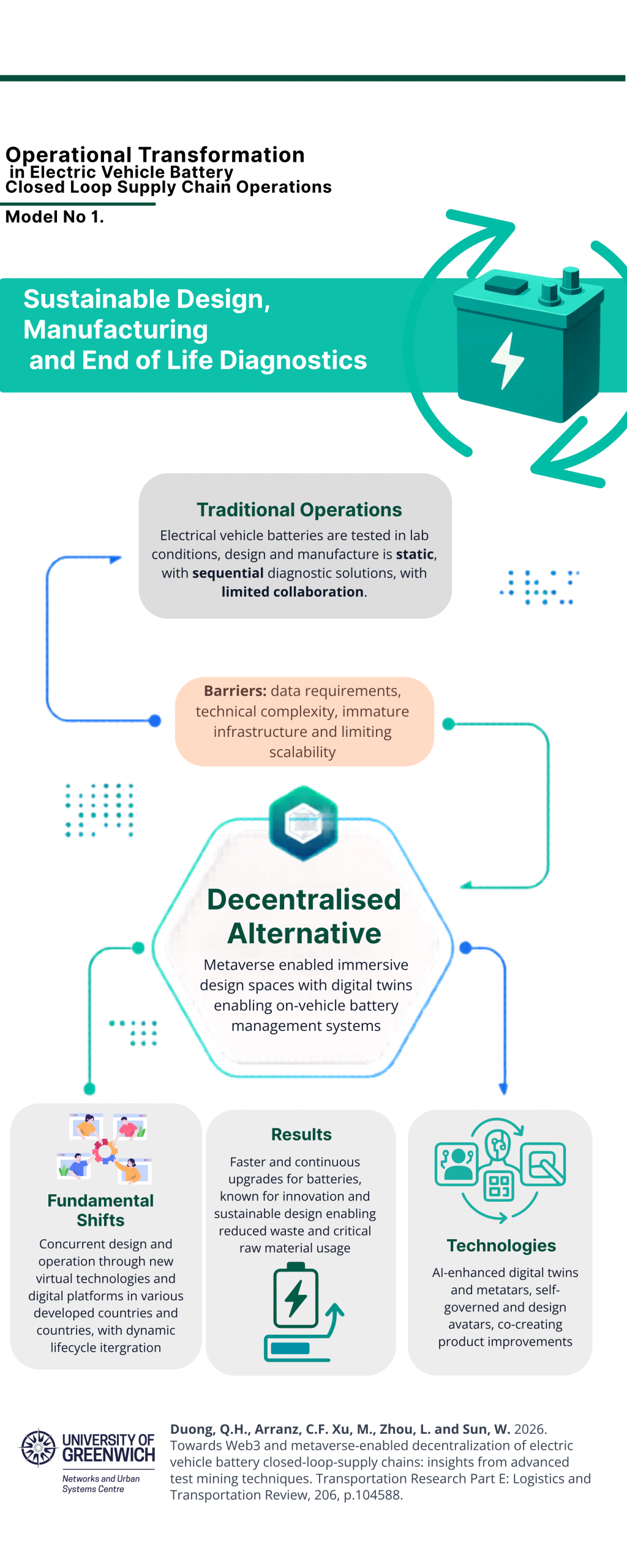
To explore the other models, and how they might transform your business, take a read of the article and/or contact the authors (profiles linked earlier in the article)– they’d love to discuss this more with you!
Cover image by @suwinai-sukanants-images under Canva's Free Content License
Discover more from Networks and Urban Systems Centre (NUSC)
Subscribe to get the latest posts sent to your email.