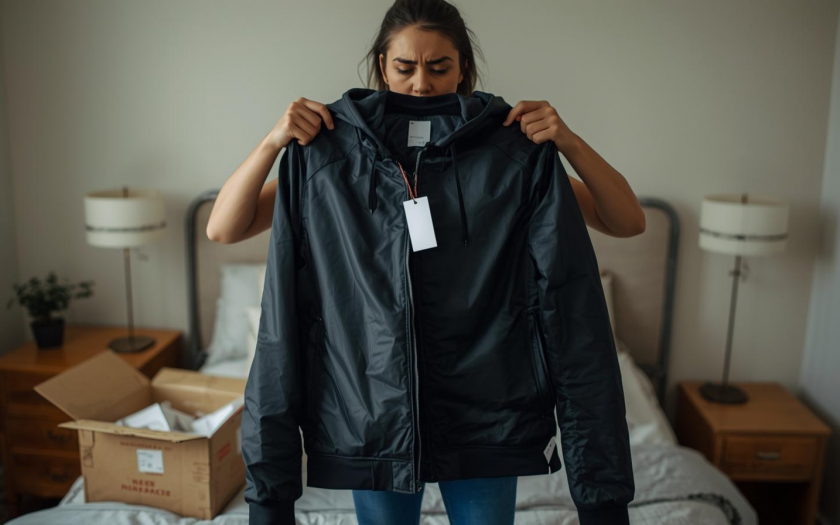
You’ve just received a parcel. It’s the jacket you ordered last week. The colour’s slightly off, the fit isn’t quite right, and the material feels cheaper than expected. You hesitate. Should you return it? You scroll through reviews, wondering if others felt the same. You sigh, toss it in the back of your wardrobe, and move on.
This everyday moment—silent dissatisfaction—is at the heart of Dr Duong’s current research. His work dives deep into the psychology of online product returns, revealing that not all returns are created equal, and not all dissatisfaction is voiced.

“I was intrigued by how customer feedback, especially user-generated information such as online reviews and seller-generated information such as prices, images, reveals not just dissatisfaction, but different styles of interactive behaviours with sellers. Some customers return assertively; others silently endure. Understanding this nuance is key to smarter operations. I have been working on a series of projects that explore online product return behaviour through the lens of customer psychology and machine learning”
His team has analysed over 200,000 verified Amazon reviews across 57,000 products, using topic modelling and semi-supervised machine learning to uncover behavioural patterns. “These insights are helping retailers rethink how they design products and communicate with customers.”
Artificial intelligence is reshaping how retailers understand and manage returns. As Dr Duong explains:
“The impact of GenAI on both text and images data is enormous which can be as negative or silver lining. This brings many challenges and opportunities to retailers.”
His current research investigates how AI can help retailers predict and manage returns more effectively, and how it can shape customer post-purchase decisions and return intentions.
He wants to know how retailers better understand and respond to different types of return behaviour. Specifically, he seeks to understand what product and service attributes trigger assertive complaints versus silent dissatisfaction, and how AI and customer feedback be used to mitigate costly returns.
“We’re exploring how AI can be used not just to predict returns, but to personalise post-purchase support based on customer interaction styles. This opens up exciting opportunities for collaboration with customer service platforms and behavioural analytics teams.”
Key Findings.
Dr Duong’s work challenges the idea that returns are purely operational issues. Instead, it positions them as behavioural feedback loops that, if understood correctly, can drive better product design, service delivery, and customer loyalty.
“One surprising finding is that product information mismatch does not always lead to assertive returns. Many customers internalise the blame or avoid taking action, which highlights the importance of addressing silent dissatisfaction.”
This silent dissatisfaction is a blind spot for many retailers. His findings suggest that one-size-fits-all return policies don’t work. Instead, he advocates for differentiated strategies that consider customer assertiveness, product type, and perceived value.
“We hope to shift the industry mindset from treating returns as a logistical problem to viewing them as behavioural signals. Our goal is to help retailers design more empathetic and effective return policies, improve product quality, and engage with customers more meaningfully.”
These strategies also have the potential to reduce the environmental waste generated by excessive returns—an issue highlighted by the European Environment Agency and National Retail Federation.
What Next?
Dr Duong’s work is a call to rethink return policies, moving away from one-size-fits-all approaches toward differentiated strategies that consider customer assertiveness, product type, and perceived value.
Dr Duong is now expanding into visual perception research, examining how product images influence post-purchase regret and return decisions. His team is preparing a new publication on image-based return triggers, and is actively seeking collaborations with UX designers and AI developers.
His recent paper on assertive vs non-assertive return behaviour was published in the International Journal of Operations & Production Management (AJG4/Q1), with a follow-up study already in development.
What’s your experience with product returns—assertive or silent? Let us know in the comments.
Interested in collaborating or learning more? Contact Dr Duong.
Found this insightful? Share it with your network.
#RetailInnovation #ConsumerBehaviour #ReturnsManagement #AIinRetail #BehaviouralAnalytics #CustomerExperience #SustainableRetail #MachineLearning #SilentDissatisfaction #NUSCResearch #SneakPeek
Want to dive deeper?
Explore the work informing this post and more of Dr Duong’s research.
Abdulla, H., Ketzenberg, M., Abbey, J.D. and Heim, G.R. (2025), “The point of no return? Restrictive changes to lenient return policies and consumer reactions to them”, Journal of Operations Management, John Wiley & Sons, Ltd, Vol. 71 No. 1, pp. 81–108, doi: 10.1002/JOOM.1346.
Duong, Q.H., Zhou, L., Meng, M., Dang, L.T.A. and Nguyen, T.D. (2025), “Striking the right balance: Customising return policy leniency for managing customer online return proclivity and satisfaction”, Journal of Retailing and Consumer Services, Pergamon, Vol. 85, p. 104315, doi: 10.1016/J.JRETCONSER.2025.104315.
Duong, Q.H., Zhou, L., Meng, M. and Nguyen, T. Van. (2025), “Unlocking online product return behaviour: the influence of product attributes on customer interaction styles”, International Journal of Operations & Production Management, Emerald Publishing, Vol. 45 No. 13, pp. 166–203, doi: 10.1108/IJOPM-08-2024-0685.
Duong, Q.H., Zhou, L., Meng, M., Nguyen, T. Van, Ieromonachou, P. and Nguyen, D.T. (2022), “Understanding product returns: A systematic literature review using machine learning and bibliometric analysis”, International Journal of Production Economics, Vol. 243, p. 108340, doi: 10.1016/j.ijpe.2021.108340.
Duong, Q.H., Zhou, L., Van Nguyen, T. and Meng, M. (2025), “Understanding and predicting online product return behavior: An interpretable machine learning approach”, International Journal of Production Economics, Elsevier, Vol. 280, p. 109499, doi: 10.1016/j.ijpe.2024.109499.
European Environment Agency. (2024), “Many returned and unsold textiles end up destroyed in Europe”, European Environment Agency, 4 March, available at: https://www.eea.europa.eu/en/newsroom/news/many-returned-and-unsold-textiles?utm_source=chatgpt.com (accessed 10 April 2025).
Ketzenberg, M.E., Abbey, J.D., Heim, G.R. and Kumar, S. (2020), “Assessing customer return behaviors through data analytics”, Journal of Operations Management, Vol. 66 No. 6, pp. 622–645, doi: 10.1002/joom.1086.
National Retail Federation. (2023), “2023 Consumer Returns in the Retail Industry”, National Retail Federation, 22 December, available at: https://nrf.com/research/2023-consumer-returns-retail-industry (accessed 6 August 2024).
Wachter, K., Vitell, S.J., Shelton, R.K. and Park, K. (2012), “Exploring consumer orientation toward returns: unethical dimensions”, Business Ethics: A European Review, Vol. 21 No. 1, pp. 115–128, doi: 10.1111/j.1467-8608.2011.01639.x.
Disclosure: This blog post was drafted and polished with the assistance of AI tools to enhance clarity, structure, and engagement. AI was also used to generate accompanying images where applicable. All content has been reviewed and approved by the author and named lead researcher to ensure accuracy and alignment with the intended message.