

You run a luxury handbag business. A customer buys one of your high-end pieces, and everything seems perfect- until you get a return request. No big deal, right? Returns happen. But when the parcel arrives, something feels off. Inside is a handbag that looks like yours, but it’s not. It’s a counterfeit. The customer insists they sent back what they received, and with no way to prove otherwise, you’re left issuing a refund and absorbing the loss.
Reverse logistics – the process of moving goods from consumers back to manufacturers for reuse, recycling, or disposal – is a critical component of the circular economy. Traditionally, this process has been plagued by inefficiencies, high costs, and lack of transparency.
This handbag scenario isn’t just a hypothetical – it’s a real-world example which highlights a growing challenge in reverse logistics: fraud, inefficiency, and waste. So, how can businesses protect themselves and reduce waste in the returns process? Could blockchain technology be the answer? And if so, what drives companies to adopt it?
Blockchain is simply a distributed digital ledger technology – that is, a record of transactions. They are designed in such a way that it is secure, transparent, and tamper-proof. Blockchains can contain smart contracts- these are automatically executed processes that do not require an intermediary. For example, when a return is scanned in, a smart contract might automatically refund a consumer – if the associated barcode is the same as what was initially sent – without the need for a person to do this. Blockchains are immutable because data recorded on a blockchain cannot be altered or deleted without obvious detection.
By creating secure, tamper-proof records, blockchain enables logistics firms to track products throughout their lifecycle, ensuring accountability and reducing fraud.
So, when and why is it used?
These are the questions that Dr Kunle Oguntegbe and his colleagues in Naples, Prof Nadia Di Paola and Prof Roberto Vona address in their recent research article.
Businesses need to consider the propensity for opportunistic behaviours and the need to maintain a competitive advantage – ultimately finding ways to increase prices or reduce costs.
Dr Oguntegbe and colleagues searched the top 50 largest logistic firms in the US for companies who use blockchain, practice reverse logistics and are committed to circular economy objectives- based on these criteria, they identified 24 companies for further analysis. They then analysed news articles on these companies to identify enablers, strategies and outcomes of blockchain adoption in reverse logistics.
This is what they found.
Enablers: why would you adopt blockchain?
- You can use it to assess the quality of returns and detect counterfeit, and this can reduce transaction costs and enhance operational efficiency
- It will help in evaluating the quality of returns – that is, you can use it to check if what the customer says is true as stored information (e.g., the weight of the parcel you sent out) cannot be altered.
- It will help you to address transport visibility concerns, for example, where shipping delays are occurring (or not).
- It will help you to scale to meet demand by helping you to meet more customer demands more efficiently when moving to e-commerce.
Beyond the needs of individual businesses, external considerations can push companies towards blockchain adoption. Dr Oguntegbe and colleagues identified four more enablers for organisations:
- Since blockchain enhances efficiency and information sharing across partners, it leads to supply chain optimisation helping businesses to balance demand and supply.
- Blockchain helps to boost e-commerce, allowing the creation of transparent and community driven market places.
- It represents a shared cognition between partners in the supply chain – a common language across different systems which helps different organisations work together
- Perhaps most importantly, it provides information security on product shipping data- protecting confidential information. Smart contracts, removing the need for human intervention, can facilitate the movement of goods and services without exposing consumer’s private information to unnecessary third parties.
Strategies: how would you adopt blockchain?
Dr Oguntegbe, looking at successful firms, identifies three strategies you need to implement blockchain into reverse logistics. Where do returns end up? Do we send them back to the vendor, to be restocked, to be liquidated, recycled, or salvaged? Returns analysis is a key strategy for firms to ensure that waste and losses are minimised by identifying and addressing holes in the returns process. You will also need collaborations – leveraging strategic partnerships and utilising blockchains with partners, distribution outlets and logistics operators. Finally, you need transformation strategy programmes to train managers on how to drive supply chain circularity.
Outcomes: what happens when you adopt blockchain?
- By carefully examining returned products, verifying the blockchain information and making recommendations for the best disposal method you will achieve efficient return processing and waste reductions.
- By partnering with other firms using blockchain to achieve common purposes, whether that be supply chain optimisation or fraud prevention, you will optimise return processes, prevent fraud and reduce risks
- And ultimately, by training managers to drive supply chain circularity with technology you will save money
We have seen why blockchain should be adopted on return processes, how it can be adopted, and the benefits to its adoption – so an important question remains, what is stopping you and your business from adopting blockchain technology? We would love to hear from you in the comments.
Want to know more? Read the full research article here.
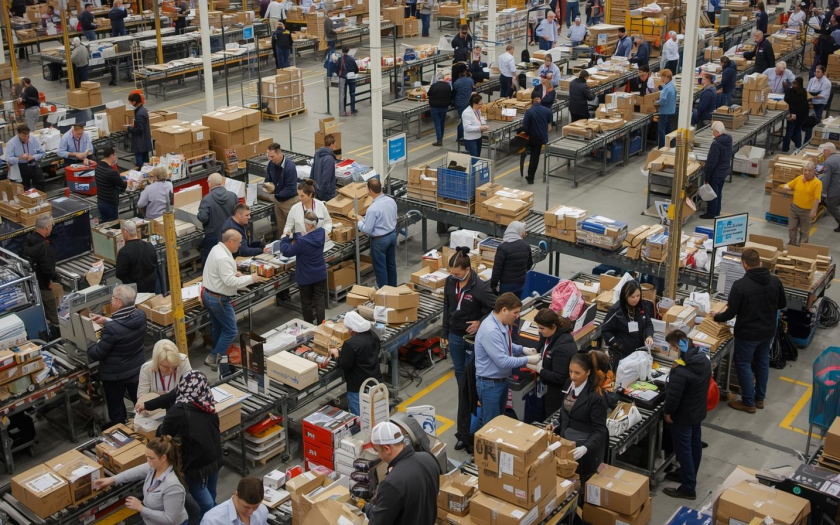
AI Disclosure statement: Generative AI was used in to generate the cover image for this article. However, it was not used to write, edit or refine the text within this article.
Discover more from Networks and Urban Systems Centre (NUSC)
Subscribe to get the latest posts sent to your email.