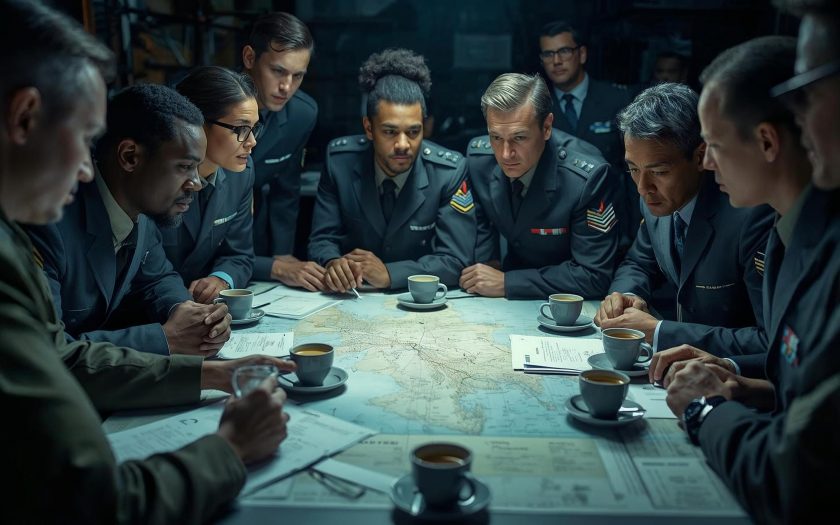

The map room hums with servers and low voices. Coffee rings stain the edges of a thick After Action Report, its spine cracked from travel, a mistake learned the hard way. “We captured the lesson,” the lieutenant says, “but the changes never became practice.” Heads nod around the table.
The lesson is there — buried in a PDF, referenced in a PowerPoint, archived in a SharePoint folder named after last year’s exercise, based on an entry in a formal Lessons Learned portal. The official process is immaculate, but the next patrol leaves with what their commander believes will fit the ever-shifting context, with no time to search the Lessons Learned database: a briefing, a map, trust in the seasoned subordinates and their experiences, a hope not to repeat mistakes.
Why do high-stakes organisations struggle to learn from their mistakes? NATO militaries invest heavily in formal learning processes – carefully designed systems for capturing lessons. Yet knowledge can fragment, innovations stall, motivation to contribute wanes, and insights fail to stick.
Working with Lt. Colonel Dr. Martijn van der Vorm and Prof. Dyson, NUSC’s own Dr John Tull examined the Netherlands Army’s intelligence transformation in Mali.
This work reveals three critical practice dimensions to strategy research:
- Relationality reveals how knowledge actually flows, often diverging from official channels.
- Temporality exposes competing time horizons that fragment learning.
- Structuring illuminates how material and social contexts shape what people can do, regardless of resources.
Research focusing on resources, culture, or strategy isn’t enough. You must unpick the invisible web of daily practices that enable, accelerate or sabotage change – whether in implementing AI systems, introducing new processes, transforming skills, or creating new career paths.
Drawing on comparative insights from Estonia, Netherlands, and Ukraine, John’s research is unique in both aims and scale – 71 in-depth interviews across ranks and gender – and in its practical focus.
The patterns will look familiar to many managers struggling with generating more adaptation and innovation in their operations:
- Informal learning dominates, but remains fragile.
- Formal processes lack visibility and trust.
- Identity and tempo shape what gets shared.
- Political constraints steer what receives action.
Dr. John Tull’s research with Professor Tom Dyson from Royal Holloway tells us the main problem isn’t the learning processes; it’s how hard-won lessons translate into living practice.
Importantly, the underlying key challenge extends beyond Defence; corporate headquarters face similar barriers in sharing best practices between business subsidiaries, partner networks or R&D centres; public sector organisations grapple with similar tensions in better using resources and sharing lessons.
The problem is universal.
We identified two key takeaways, applicable to any sector. First, leaders need to bridge informal and formal learning through structured handovers and feedback loops. Second, they need to embed learning into career pathways – not just procedures – to retain talent and foster innovation. The Portuguese Army is already implementing these recommendations, including insights they now share with the national wildfire agency.
Beyond Military Contexts
The military has long been the archetype for organisational processes. ‘Headquarters’, ‘field operations’, ‘campaigns’, ‘lessons learned’ – all these concepts originated in military contexts, before spreading wider. This research will similarly influence a wider set of stakeholders.
Consider recent business management research showing that well-executed AI investments struggle with implementation. The problem isn’t technological – it’s organisational (as MIT’s reported “95% failure” finding of AI pilots indicates).
What’s the problem? Companies ignore existing ways of working, their embedded practices; managers tend to focus on what people should do rather than what they actually do…and the related issues of why and how to align new processes with work realities. Our research addresses this squarely.
Recent publications mentioned:
- Dyson, T., Tull, J. and van der Vorm, M. (2025) Battlefield Knowledge and Barracks Reality: Learning Practices within the Netherlands Armed Forces. Journal of Strategic Studies.
- Dyson, T. and Tull, J. (2025) Portuguese Army Lesson Learning: Challenges and Opportunities in a Volatile Environment, Revista Marquês de Sá da Bandeira, Série II, N.º 1., Lisbon.
- Tull, J. Dyson, T. and Pashchuk, Y. (2024). Rapid-cycle learning for effective remedial action & dissemination: Ukraine EOD case study, in: Future EOD Development in Light of the Modern Conflicts and Technological Progress – NATO EOD Demonstrations and Trials 2023 Proceedings. ISBN 978-80-974787-0-4
Note: Project was funded by the UK’s ESRC (2021-2025): ‘A Revolution in Military Learning? Understanding the Potential of Lessons-Learned Processes’ (ES/V004190/1).
Join the Conversation
What’s one hard-earned lesson your organisation struggles to transfer or integrate into transformative change?
Whether defence, public service, or private enterprise, we’d value your perspective on how organisations can better learn from experience.
Share your thoughts below. Innovation thrives where structure meets trust. The future isn’t just strategic – it’s relational.
#NUSCResearch #OrganisationalLearning #KnowledgeExchange #DefenceResearch #NATO #MilitaryInnovation #PublicSectorInnovation #ESRCResearch #ResearchImpact #LessonsLearned
Disclosure: This blog post was drafted and polished with the assistance of AI tools to enhance clarity, structure, and engagement. All content has been reviewed and approved by the author to ensure accuracy and alignment with the intended message.